A muscular athlete and someone carrying excess visceral fat can post the exact same BMI number — and get the exact same "overweight" label from a calculation that has no way to tell the difference between muscle and fat. That single flaw is why doctors increasingly look past BMI alone toward metrics that actually account for body composition and fat distribution.
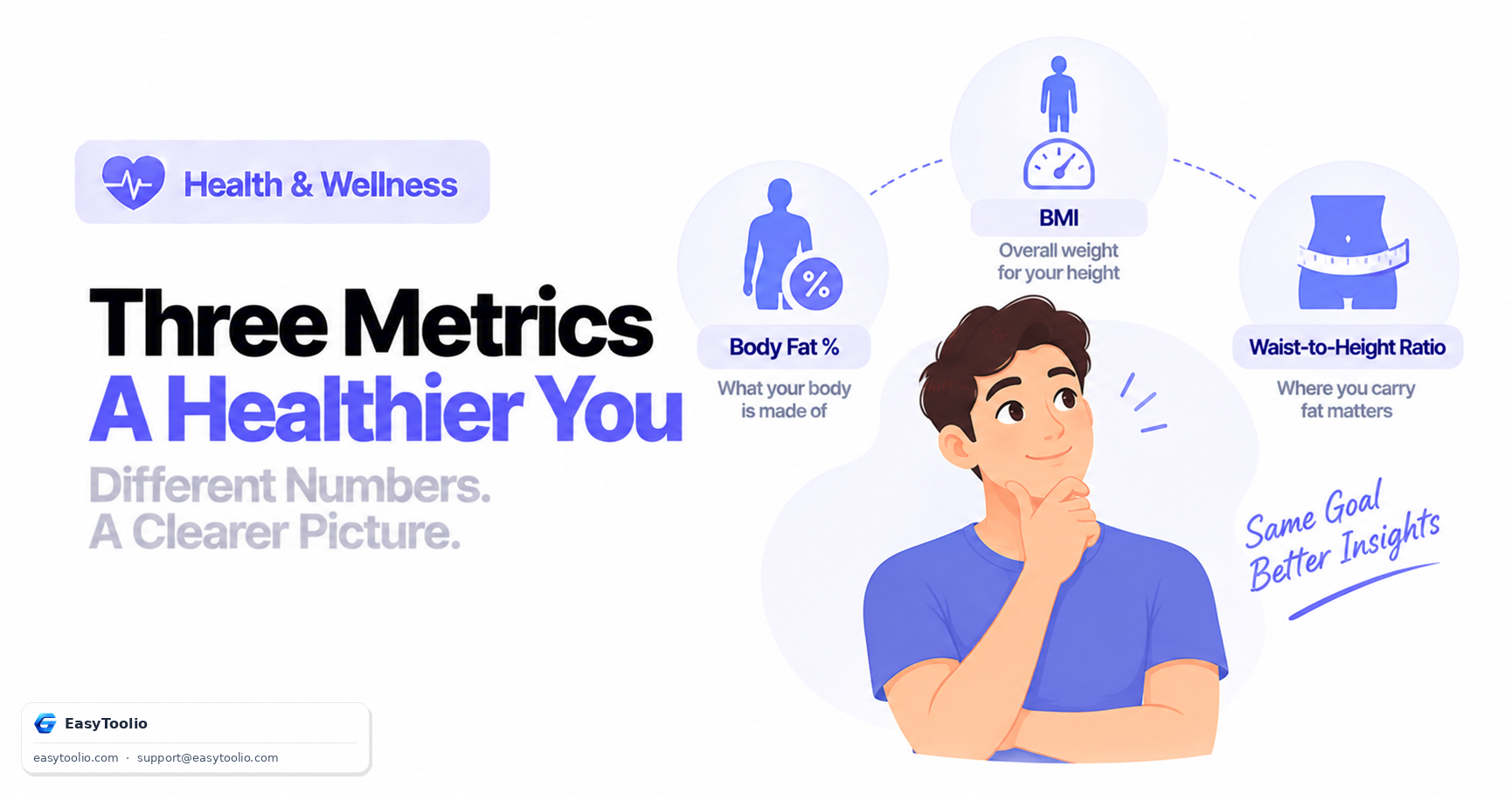
Direct Answer: BMI (weight in kg ÷ height in meters squared) is a quick population-level screening proxy that cannot distinguish muscle from fat, which is why it frequently misclassifies muscular individuals as "overweight" or "obese." Body fat percentage measures actual body composition — the proportion of your total weight that is fat tissue versus lean mass — giving a far more accurate individual picture. Waist-to-height ratio (waist circumference ÷ height) is a proxy specifically for abdominal/visceral fat, which correlates more strongly with cardiometabolic risk than overall body fat percentage or BMI alone. Using a BMI calculator, body fat calculator, and waist-to-height ratio calculator together gives a fuller picture than trusting any single number in isolation.
What Each Metric Actually Measures
BMI is a simple ratio: weight (kg) divided by height (meters) squared. It was designed in the 1830s by a Belgian statistician for population-level statistics, not individual diagnosis, and it makes no distinction whatsoever between fat mass and muscle mass — a kilogram of muscle and a kilogram of fat weigh the same and count identically toward the BMI formula.
Body fat percentage measures what BMI cannot: the actual proportion of your body weight that is fat tissue versus lean mass (muscle, bone, organs, water). It's typically estimated through skinfold calipers, bioelectrical impedance scales, or more precise methods like DEXA scans, and it directly answers the question BMI only guesses at.
Waist-to-height ratio (WHtR) divides waist circumference by height, producing a simple ratio that serves as a proxy specifically for abdominal (visceral) fat — the fat stored around internal organs, which is more metabolically active and more strongly linked to cardiovascular and metabolic disease risk than fat stored elsewhere on the body (like hips or thighs).
Where BMI Famously Fails
The textbook example is the muscular athlete: a bodybuilder or rugby player at 6 feet tall and 220 lbs of mostly muscle can post a BMI over 28 (technically "overweight," bordering on "obese"), despite having a body fat percentage well within a healthy athletic range. BMI's inability to separate muscle from fat means it systematically misclassifies:
- Muscular athletes and bodybuilders as overweight or obese
- Older adults with age-related muscle loss (sarcopenia) as "normal weight," even when their fat percentage is actually elevated
- People of different ethnic backgrounds, for whom research has shown the same BMI number can correspond to meaningfully different health risk levels
Comparing the Three Metrics
| Metric | What It Measures | Best For | Key Limitation |
|---|---|---|---|
| BMI | Weight relative to height (proxy only) | Fast population-level screening | Can't distinguish muscle from fat |
| Body Fat % | Actual proportion of fat vs. lean mass | Individual body composition tracking | Requires a scan, scale, or caliper measurement to estimate |
| Waist-to-Height Ratio | Abdominal/visceral fat proxy | Cardiometabolic risk screening | Doesn't capture overall body composition, only fat distribution |
Why Doctors Increasingly Favor Waist-Based Metrics for Cardiometabolic Risk
A growing body of clinical research has found that where fat is stored matters as much as how much total fat someone carries. Visceral fat around the abdomen is more metabolically active — it's more strongly associated with insulin resistance, type 2 diabetes risk, and cardiovascular disease than subcutaneous fat stored elsewhere on the body. Two people with identical BMI and even identical total body fat percentage can carry meaningfully different cardiometabolic risk if one stores fat predominantly around the waist and the other around the hips and thighs — which is exactly the distinction waist-to-height ratio is designed to capture that neither BMI nor overall body fat percentage can.
Why Using All Three Together Beats Trusting Any One Number
No single metric tells the complete story:
- BMI flags population-level risk quickly but can't see composition or fat distribution.
- Body fat percentage corrects for the muscle-vs-fat blind spot but doesn't say where that fat sits.
- Waist-to-height ratio corrects for the distribution blind spot but doesn't capture your overall composition on its own.
Checked together, the three metrics cross-validate each other — a muscular person with a high BMI but healthy body fat percentage and a low waist-to-height ratio has a very different risk picture than someone with the same BMI but elevated readings on the other two.
Frequently Asked Questions
Is BMI completely useless, then?
No — it remains a fast, free, and reasonably useful screening tool at a population level, and for most people without unusual muscle mass, it does correlate loosely with body fat. The issue is treating it as a precise individual diagnosis rather than what it actually is: a quick proxy that works better in aggregate than for any one specific person.
What's considered a healthy waist-to-height ratio?
A commonly cited guideline is keeping waist circumference below half your height (a ratio under 0.5), which several studies have found correlates more consistently with cardiometabolic risk across different body types and ethnicities than BMI thresholds alone.
How accurate are home body fat scales compared to a DEXA scan?
Bioelectrical impedance scales (the common home body fat scale) are reasonably useful for tracking your own trend over time but can vary by several percentage points depending on hydration level and time of day, whereas a DEXA scan is considered a clinical-grade reference standard. For most people, consistent home tracking under similar conditions is a practical middle ground.
Which metric should I prioritize if I can only track one?
There's no universally "best" single metric — the whole point is that each one covers a blind spot in the others. If forced to pick one for general cardiometabolic risk screening, waist-to-height ratio is increasingly favored by researchers, but tracking all three together gives a meaningfully fuller picture than any single number.
Can BMI, body fat percentage, and waist-to-height ratio all be normal while a health risk still exists?
Yes — no combination of body measurement metrics captures everything relevant to health (blood pressure, cholesterol, blood sugar, family history, and lifestyle factors also matter significantly). These three metrics are useful screening tools, not a complete medical assessment.
References: World Health Organization (WHO) guidance on BMI and obesity classification; peer-reviewed research on waist-to-height ratio as a cardiometabolic risk indicator; Mayo Clinic guidance on body composition assessment methods.