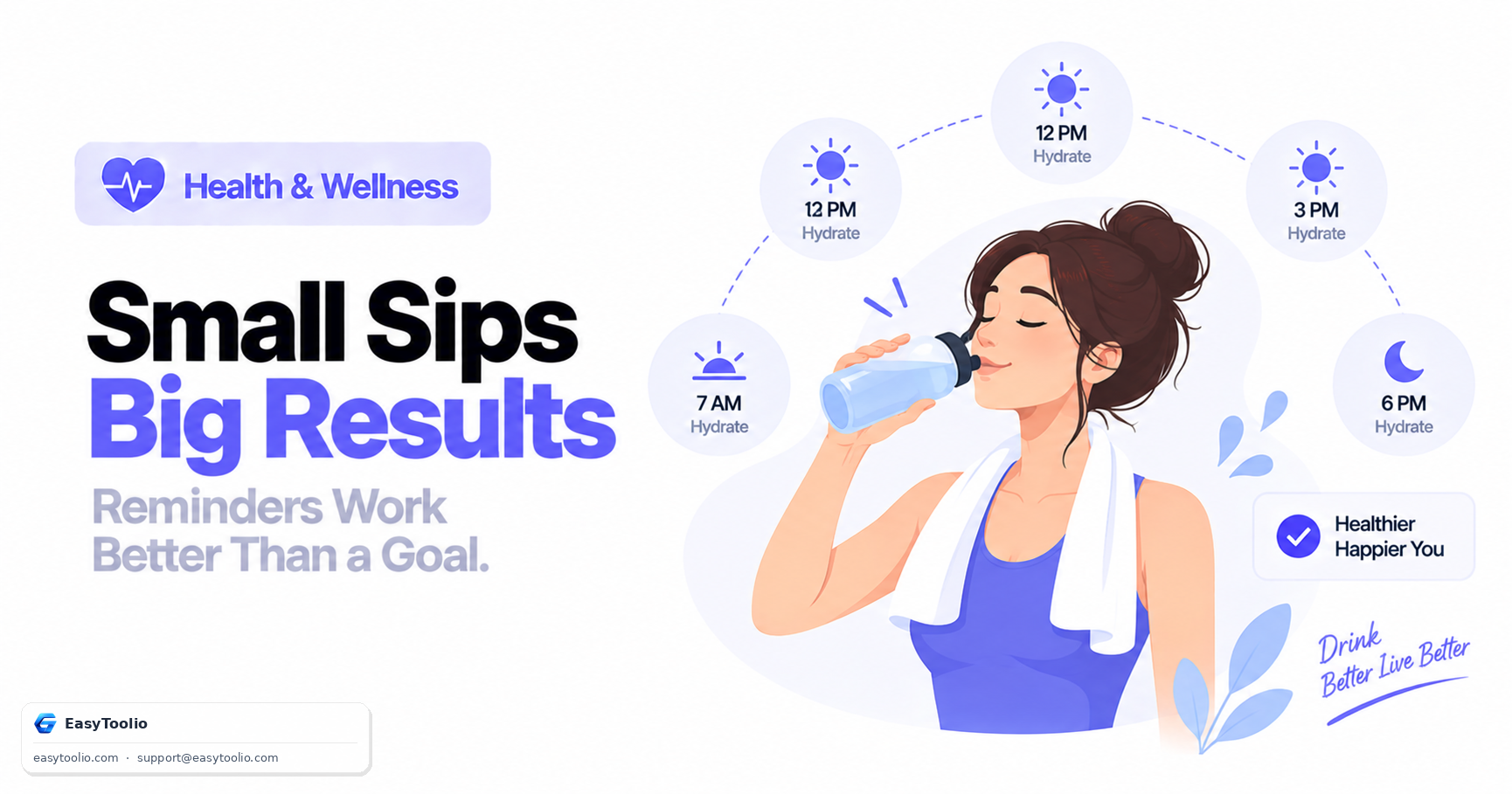
Most people can tell you their daily water target — 8 glasses, 2 liters, half their body weight in ounces — and still end most days having drunk half of it. The problem was never the number. It's that knowing a total doesn't create any cue to act on it at 10am, 2pm, or 6pm, so it quietly gets pushed to "later" until later never comes.
Direct Answer: A single daily water goal fails because it provides no trigger for action at any specific moment — it's a target with no schedule attached. Spaced reminders throughout waking hours convert an abstract daily total into a series of small, immediately actionable prompts (drink now), which is a fundamentally different behavioral mechanism than trying to remember a big number and catch up on it in the evening. A hydration reminder and tracker works by breaking the day's target into scheduled nudges rather than leaving the timing up to willpower and memory.
Why "Just Drink More Water" Doesn't Work
The gap between knowing a hydration target and hitting it isn't usually about motivation — it's about the complete absence of a cue at the moment action would actually help. Thirst itself is a lagging, unreliable signal: by the time you consciously feel thirsty, mild dehydration has often already set in, and by then the moment to "just remember" has already been missed dozens of times that day without any prompt to catch it.
This is the same behavioral gap that shows up with any goal stated as a daily total rather than a scheduled action — "read more," "stretch more," "stand up more" all suffer from the identical problem: a number with no clock attached rarely gets acted on evenly across the day.
Scheduled Nudges vs. the End-of-Day Catch-Up
Compare two approaches to the same 2.5-liter daily target:
Approach A — one daily goal, no schedule: You remember the target vaguely in the morning, get busy, forget until mid-afternoon, notice you've had one glass, and try to drink the remaining 2 liters in a few hours before bed. This isn't just inconvenient — front-loading a large volume of water into a short evening window disrupts sleep with bathroom trips and doesn't spread hydration benefits (cognitive function, temperature regulation) evenly across the hours you actually needed them.
Approach B — reminders spaced across waking hours: A prompt every 90 minutes to 2 hours for a smaller, specific amount (e.g., "drink 250ml now") turns the same 2.5-liter target into roughly 10 small, easy actions instead of one large, easy-to-avoid one. Each prompt is small enough that ignoring it feels costlier than just doing it — a 30-second action beats a vague evening reckoning.
The Behavioral Mechanism: Spacing Beats Bulk
This works for the same reason spaced repetition beats cramming in learning, or why small frequent workouts often build a habit better than one long infrequent session: a cue placed close to the moment of action is far more likely to trigger behavior than a goal held only in memory. Scheduled reminders externalize the cue — you no longer have to remember the goal exists, only respond to the prompt in front of you. Over a few weeks, many people find the behavior becomes automatic enough that the reminders start feeling redundant, at which point frequency can be dialed back.
Tuning Reminder Frequency to Your Actual Day
A fixed reminder interval that ignores context (climate, activity level, sleep hours) either annoys you into ignoring it or under-prompts on the days you need it most. A few adjustments worth making:
| Factor | Adjustment |
|---|---|
| Hot/humid climate or summer months | Increase frequency by 20-30%; sweat losses raise fluid needs meaningfully |
| Exercise or physical labor days | Add extra reminders around and after activity, not just evenly spaced |
| Office/desk-bound routine | Standard spacing (every 90 min–2 hrs) works well since thirst cues are easy to ignore while focused |
| Early wake / late sleep schedule | Shift the reminder window to match actual waking hours rather than a fixed clock-time default |
| Illness with fever or vomiting | Increase frequency temporarily; fluid needs rise significantly |
Common Mistakes People Make With Hydration Goals
- Setting the target without setting the schedule — the number matters far less than when you're prompted to act on it.
- Ignoring reminders early and then trying to "catch up" — large volumes late in the day disrupt sleep and don't replicate the benefit of steady intake.
- Using thirst alone as the trigger — by the time thirst is noticeable, you're often already behind on the day's target.
- Never adjusting frequency for activity or climate — a reminder schedule tuned for a sedentary indoor day under-serves you on a hot outdoor one.
This content is informational and not a substitute for personalized medical advice — fluid needs vary by individual health conditions, medications, and body size, so anyone with kidney, heart, or other conditions affecting fluid balance should follow their doctor's specific guidance rather than a general daily target.
Frequently Asked Questions
How often should hydration reminders be spaced during the day?
A common starting point is every 90 minutes to 2 hours during waking hours, adjusted for climate and activity level. The goal is small, frequent prompts rather than one large end-of-day push.
Is 8 glasses a day still a reasonable target?
It's a reasonable rough starting point for many adults, though actual needs vary by body size, activity, and climate. The specific number matters less than having a scheduled way to actually act on it throughout the day.
Why do I forget to drink water even when I have a tracker app open?
An app you have to remember to check has the same flaw as a goal held only in memory — it requires you to initiate the check. A reminder that actively prompts you (rather than one you have to seek out) removes that dependency on memory.
Does drinking a lot of water quickly late in the day cause problems?
It can disrupt sleep through nighttime bathroom trips and doesn't replicate the steady-state hydration benefits of spreading the same volume across the day, which is one reason spaced reminders work better than front-loaded or back-loaded drinking.
Should reminder frequency change on exercise days?
Yes — sweat losses during exercise increase fluid needs, so adding extra reminders around and shortly after physical activity, rather than relying on the same fixed schedule as a rest day, better matches actual need.
References: Mayo Clinic guidance on daily water intake and hydration; CDC guidance on water and healthier drinks.