
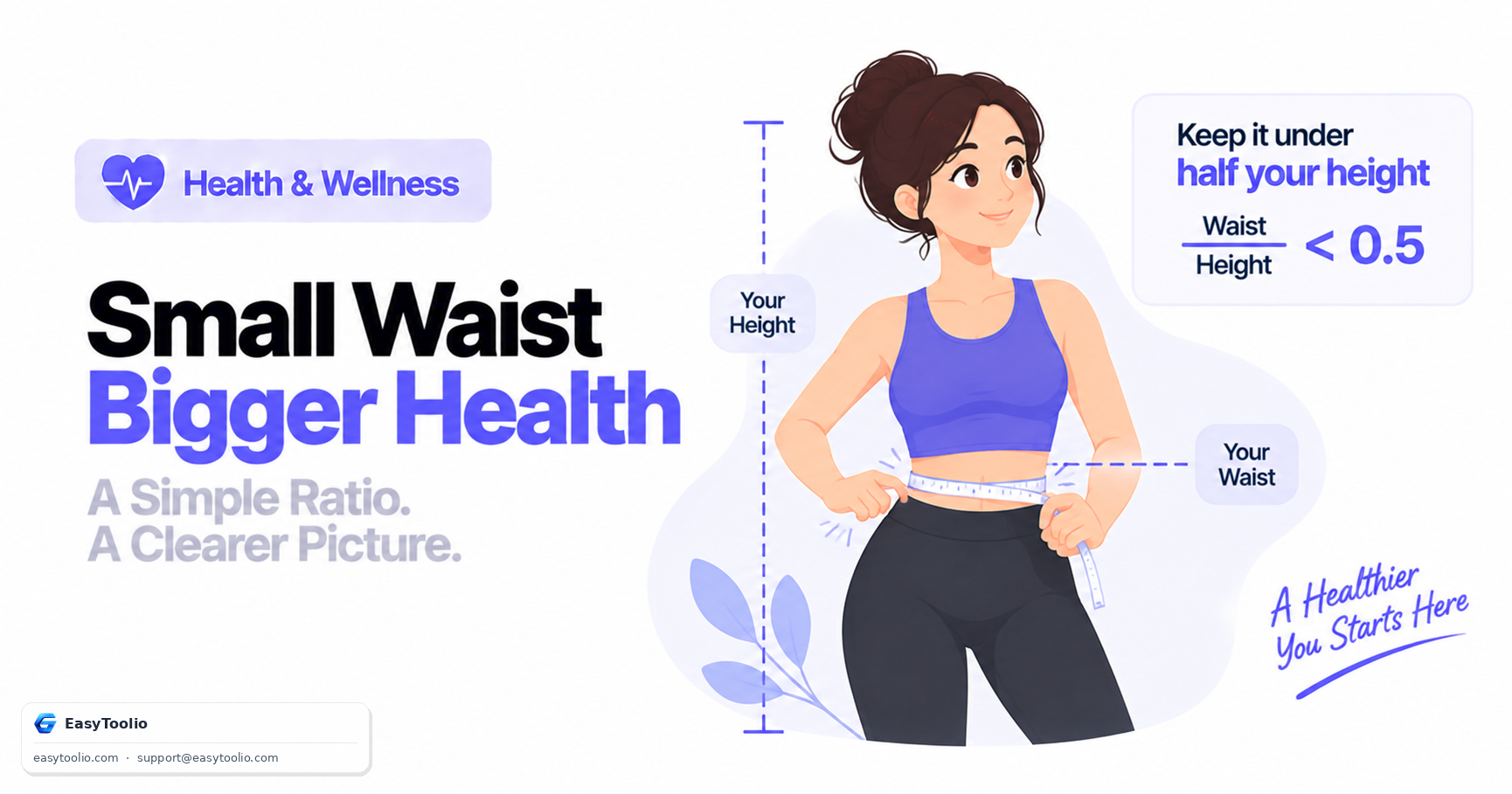
BMI tells two people with identical height and weight that they carry identical health risk, even when one carries most of their weight around the waist and the other carries it in muscle mass. Waist-to-height ratio fixes this specific blind spot with one extra measurement and a formula simple enough to do in your head.
Direct Answer: Waist-to-height ratio (WHtR) is calculated as waist circumference divided by height, both measured in the same unit. A widely cited rule of thumb is to keep your waist circumference below half your height (a ratio under 0.5), which several studies suggest correlates with lower risk of metabolic and cardiovascular problems across a wider range of body types and ethnicities than BMI thresholds alone. A ratio of 0.5-0.6 generally signals increased risk, and above 0.6 signals high risk, though WHtR should be read as a screening signal alongside other measures, not a standalone diagnosis.
The Formula and the "Keep It Under Half" Rule
Waist-to-Height Ratio (WHtR) = Waist Circumference ÷ Height
Both measurements must be in the same unit (both cm or both inches) since the ratio is unitless. Measure waist circumference at the midpoint between the lowest rib and the top of the hip bone, while standing relaxed and breathing out normally — not while holding your stomach in or pulling the tape too tight.
The popularized rule of thumb, sometimes summarized as "keep your waist circumference to less than half your height," gives a target ratio of under 0.5 for most adults. A person who is 170 cm tall would aim to keep their waist circumference under 85 cm by this rule. Calculate your own ratio instantly with our free waist-to-height ratio calculator.
Risk Category Chart
| WHtR Range | General Risk Category |
|---|---|
| Below 0.40 | May indicate underweight in some cases |
| 0.40 – 0.49 | Healthy range |
| 0.50 – 0.59 | Increased risk |
| 0.60 and above | High risk |
These bands are broadly consistent across adult men and women and, notably, appear more stable across different ethnic groups than BMI cutoffs, which is one of the reasons researchers have proposed WHtR as a supplementary or alternative screening tool.
Why WHtR May Outperform BMI for Some Body Types
BMI is a function of total weight relative to height squared — it cannot distinguish between where that weight is distributed on the body. This creates specific blind spots:
- Muscular individuals often score as "overweight" or "obese" on BMI despite low body fat and low abdominal fat, because muscle is denser than fat and BMI can't tell the difference.
- "Skinny fat" individuals with a normal BMI but high visceral (abdominal) fat can be missed entirely by BMI, even though visceral fat is specifically linked to higher cardiometabolic risk.
- Abdominal ("central") fat — the kind stored around organs rather than under the skin — is more metabolically active and more strongly linked to insulin resistance, type 2 diabetes, and cardiovascular disease than fat stored elsewhere on the body. WHtR captures this directly by measuring waist size; BMI does not measure distribution at all.
This doesn't make WHtR universally superior — it's a complementary measure that catches a specific risk pattern BMI can miss, particularly useful as a quick secondary check alongside BMI rather than a full replacement for it.
WHtR vs Waist-to-Hip Ratio
Both are waist-based measures, but they answer slightly different questions:
| Measure | Formula | What It Emphasizes |
|---|---|---|
| Waist-to-Height Ratio | Waist ÷ Height | Absolute abdominal fat relative to body frame size |
| Waist-to-Hip Ratio | Waist ÷ Hip circumference | Fat distribution pattern (apple vs pear shape) |
Waist-to-hip ratio is more specifically about body shape — distinguishing "apple-shaped" (more fat around the waist relative to hips, generally higher risk) from "pear-shaped" (more fat around the hips, generally lower relative risk) bodies. Waist-to-height ratio, by contrast, doesn't care about shape at all — it simply asks whether abdominal size is large relative to overall body frame, which many researchers find easier to interpret consistently across a general population since it doesn't require a second measurement site.
Limitations to Keep in Mind
- Not diagnostic on its own — WHtR is a screening indicator, not a medical diagnosis, and should be interpreted alongside other measures and, where relevant, a healthcare provider's assessment.
- Measurement technique matters — inconsistent tape placement or tension can meaningfully shift the result; measure at the same spot each time for tracking trends.
- Pregnancy and certain medical conditions can distort waist circumference readings independent of actual fat distribution.
- Very short or very tall individuals may see the ratio behave slightly differently at the extremes, though it generally holds up better across height ranges than BMI does across weight ranges.
Frequently Asked Questions
Is waist-to-height ratio better than BMI?
Neither measure is universally "better" — they capture different things. WHtR is often considered a useful complement to BMI because it accounts for fat distribution, which BMI ignores entirely, but using both together generally gives a more complete picture than relying on either alone.
What is a healthy waist-to-height ratio for women versus men?
The commonly cited healthy range (under 0.5) is generally applied similarly across both sexes, unlike BMI categories which sometimes differ, though some research suggests slightly different risk-onset points by sex — treat 0.5 as a general reference point for both.
How do I measure my waist correctly for this ratio?
Stand relaxed, breathe out normally, and measure at the midpoint between the bottom of your ribcage and the top of your hip bone (roughly at navel level for most people), keeping the tape snug but not compressing the skin.
Can waist-to-height ratio be used for children?
Some pediatric research supports using WHtR in children and adolescents as well, often with the same "under 0.5" guidance, but pediatric growth patterns are more variable, so any concerns for a child should go through a pediatrician rather than a general online calculator.
Does waist-to-height ratio account for muscle mass?
Not directly, but far less than BMI does — a heavily muscled abdomen and core can slightly raise waist circumference, but the effect is much smaller than the effect of overall muscle mass on total body weight (and therefore BMI), making WHtR generally more reliable for muscular individuals than BMI.
References: World Health Organization (WHO) obesity and overweight guidance; peer-reviewed public health research on waist-to-height ratio as a cardiometabolic risk screening tool.