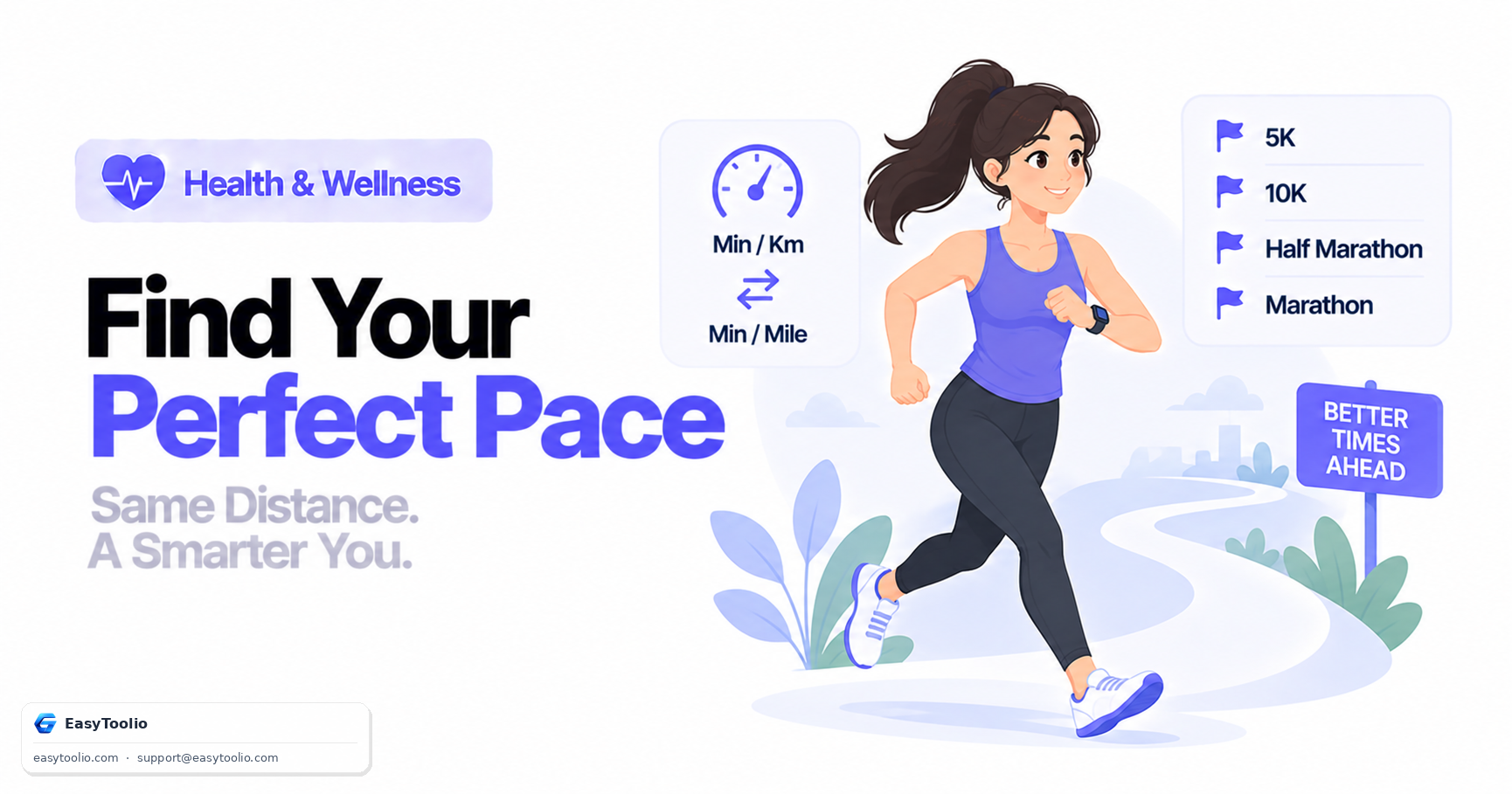
A training plan tells you to "run at 5:30 pace" and you're left doing mental math on the treadmill, or worse, realizing halfway through a race that your watch is set to miles while the course markers are in kilometers. Pace is the single most useful number in running, but only if you can convert it fluently between units and translate it into an actual finish time.
Direct Answer: Pace equals total time divided by distance, expressed as minutes per kilometer or minutes per mile. To convert between the two units, multiply min/km pace by 1.60934 to get min/mile, or multiply min/mile pace by 0.62137 to get min/km. To find a race finish time from pace, multiply your pace (in minutes per unit distance) by the total race distance in that same unit — a 5:00/km pace over a 10K distance gives a 50:00 finish time (5:00 × 10 = 50:00).
The Core Pace Formula
Everything about pace comes back to one relationship:
Pace = Time ÷ Distance
Finish Time = Pace × Distance
Distance = Time ÷ Pace
If you know any two of these three values, you can solve for the third. This is why pace calculators are structured around three input modes: given pace and distance, solve for time; given time and distance, solve for pace; given time and pace, solve for distance.
Converting Between Min/Km and Min/Mile
Because 1 mile equals 1.60934 kilometers, the conversion factor between the two pace units follows directly:
Pace (min/mile) = Pace (min/km) × 1.60934
Pace (min/km)   = Pace (min/mile) × 0.62137
A common mental shortcut: min/mile pace is roughly 1.6× slower-looking than min/km pace for the same actual speed, because a mile is a longer distance than a kilometer — so a 5:00/km pace corresponds to roughly an 8:03/mile pace, not the other way around. Runners training with a km-based watch who read a mile-based training plan (or vice versa) frequently misjudge their effort because they don't apply this conversion.
Convert your training pace between units and project race finish times instantly using our pace calculator instead of doing the multiplication on the fly mid-run.
Pace-to-Finish-Time Reference Table
This table shows finish times across common race distances for a range of typical training paces:
| Pace (min/km) | Pace (min/mile) | 5K | 10K | Half Marathon (21.1K) | Marathon (42.2K) |
|---|---|---|---|---|---|
| 4:00/km | 6:26/mi | 20:00 | 40:00 | 1:24:24 | 2:48:48 |
| 4:30/km | 7:14/mi | 22:30 | 45:00 | 1:34:57 | 3:09:54 |
| 5:00/km | 8:03/mi | 25:00 | 50:00 | 1:45:30 | 3:31:00 |
| 5:30/km | 8:51/mi | 27:30 | 55:00 | 1:56:03 | 3:52:06 |
| 6:00/km | 9:39/mi | 30:00 | 1:00:00 | 2:06:36 | 4:13:12 |
| 6:30/km | 10:28/mi | 32:30 | 1:05:00 | 2:17:09 | 4:34:18 |
| 7:00/km | 11:16/mi | 35:00 | 1:10:00 | 2:27:42 | 4:55:24 |
Using Pace to Plan Race-Day Splits
Elite and experienced runners rarely just "run by feel" over a full race — they plan splits, meaning target time checkpoints at regular distance intervals, based on their goal pace:
- Set your goal finish time, then divide by the total distance to get your required average pace.
- Break the race into kilometer or mile splits and calculate the target cumulative time at each one (e.g., for a 4:00:00 marathon goal at roughly 5:41/km, the 10K mark should be hit around 56:50, the halfway mark around 1:59:40).
- Account for a slight positive or negative split strategy — many coaches recommend running the first half marginally slower than goal pace and the second half marginally faster (a "negative split"), since starting conservatively reduces the risk of a late-race blowup.
- Adjust for terrain and conditions — uphill sections, heat, and altitude all justify deviating from a flat, even-split plan, and pace calculators using flat-course assumptions won't automatically account for this.
Common Pace Calculation Mistakes
- Confusing average pace with instantaneous pace — a GPS watch shows real-time (instantaneous) pace, which fluctuates with terrain and effort, while race splits are based on average pace over a segment.
- Forgetting GPS drift — GPS watches can overstate distance slightly on winding trails or in urban canyons with tall buildings, which skews the pace calculation even if your actual effort was consistent.
- Mixing units mid-calculation — entering a mile-based pace into a kilometer-based finish time formula without converting first is one of the most common self-inflicted pacing errors.
Frequently Asked Questions
What is a "good" running pace for a beginner?
There's no universal answer — a good beginner pace is simply one that's sustainable for the full planned distance, typically in a range where you can still hold a short conversation (often called "conversational pace"). Comparing your pace to elite runners or online averages is far less useful than tracking your own pace improving over time.
How do I convert a treadmill speed (km/h or mph) into pace?
Divide 60 by the speed to get minutes per unit distance: 60 ÷ speed (km/h) = pace in min/km, and 60 ÷ speed (mph) = pace in min/mile. For example, a treadmill set to 10 km/h equals a 6:00/km pace (60 ÷ 10 = 6).
Why does my watch's average pace differ from my calculated race pace?
Your watch's average pace includes GPS inaccuracies, brief stops, and pace fluctuations from terrain, while a calculated race pace from your official finish time and the certified course distance is typically more accurate as a single overall figure.
Should I train at my goal race pace or slower?
Most training plans recommend the majority of weekly mileage at an easier pace than goal race pace, with only specific workouts (tempo runs, intervals) run at or near goal pace. Running every training run at race pace significantly increases injury and burnout risk.
Is min/km or min/mile more commonly used?
It depends on the country and race — most of the world (Europe, Asia, most international races) uses kilometers, while the US, UK, and a few other countries commonly use miles for both training and racing, so it's worth checking your GPS watch's default unit setting before travel or an international race.
References: World Athletics competition rules and record-keeping standards; USA Track & Field (USATF) course certification and pacing guidance.