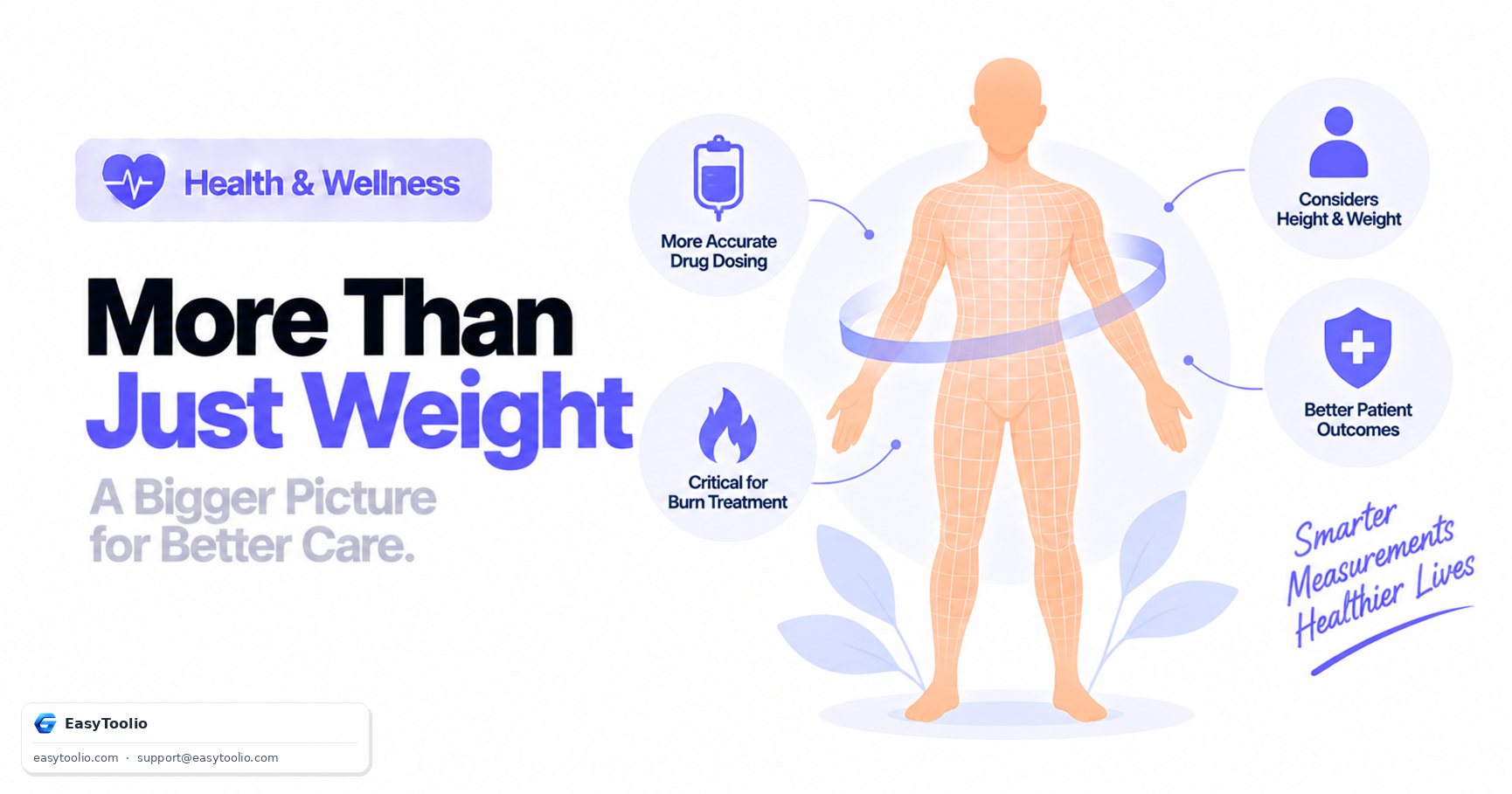
Two adult patients can weigh the same 70 kilograms and still need meaningfully different chemotherapy doses, because weight alone doesn't capture how much of the body's surface is actually available for drug distribution, heat exchange, and fluid loss. This is exactly the gap body surface area (BSA) was designed to close, and it's why it shows up so consistently in oncology, burn care, and pediatric dosing protocols instead of weight-based dosing alone.
Direct Answer: Body surface area is most commonly calculated using the Mosteller formula: BSA (m²) = √[(height in cm × weight in kg) / 3600], which is simpler and nearly as accurate as the older DuBois formula: BSA = 0.007184 × height(cm)^0.725 × weight(kg)^0.425. BSA correlates more closely with metabolic rate, cardiac output, and drug clearance than body weight alone does, which is why chemotherapy dosing, burn injury assessment, and some pediatric drug protocols calculate doses per square meter of body surface area rather than per kilogram of body weight.
The Two Standard BSA Formulas
| Formula | Equation | Notes |
|---|---|---|
| Mosteller (1987) | √[(height(cm) × weight(kg)) / 3600] | Simpler, widely used in clinical practice today |
| DuBois & DuBois (1916) | 0.007184 × height(cm)^0.725 × weight(kg)^0.425 | Older, derived from a small sample (9 subjects), still referenced in literature |
| Haycock (1978) | 0.024265 × height(cm)^0.3964 × weight(kg)^0.5378 | Often preferred for infants and children |
| Gehan & George (1970) | 0.0235 × height(cm)^0.42246 × weight(kg)^0.51456 | Used in some oncology contexts |
Mosteller has become the most widely used formula in modern clinical settings largely because it's computationally simple (a single square root) while producing results within a few percent of the more complex DuBois formula across most adult body types.
Worked Example
For an adult who is 170 cm tall and weighs 70 kg, using the Mosteller formula:
BSA = √[(170 × 70) / 3600]
BSA = √[11900 / 3600]
BSA = √3.3056
BSA ≈ 1.82 m²
The average adult BSA is commonly cited as approximately 1.7 m² for women and 1.9 m² for men, though this varies significantly with height and weight, which is precisely the point — BSA scales with both dimensions rather than weight alone.
Calculate your own BSA using either standard formula with our body surface area calculator instead of computing the fractional exponents by hand.
Why BSA-Based Dosing Beats Weight-Based Dosing in Certain Contexts
Weight alone doesn't account for the fact that a taller, leaner person and a shorter, heavier person of identical body weight can have very different metabolic rates, blood volumes, and cardiac outputs — both of which affect how a drug is distributed and cleared from the body. BSA correlates more closely with these physiological variables because it factors in height alongside weight, rather than weight in isolation. This matters most in contexts with a narrow therapeutic window, where under-dosing risks treatment failure and over-dosing risks serious toxicity:
- Chemotherapy: Most cytotoxic chemotherapy drugs are dosed in mg per m² of BSA, since these drugs have narrow safety margins and BSA-based dosing has historically produced more consistent outcomes across body types than flat or weight-based dosing.
- Burn assessment: The "Rule of Nines" and Lund-Browder chart estimate the percentage of total body surface area affected by burns, which directly drives fluid resuscitation calculations (e.g., the Parkland formula uses % BSA burned × body weight to calculate initial IV fluid requirements).
- Pediatric dosing: Children have proportionally larger BSA relative to weight than adults, and some pediatric drug protocols use BSA-based dosing to more accurately scale adult-derived dosing guidelines down to a child's physiology.
- Cardiac index: Cardiac output is often normalized to BSA (producing "cardiac index," output per m²) specifically because it allows meaningful comparison of heart function across patients of different body sizes.
Normal BSA Ranges by Age and Sex
| Age Group | Approximate Average BSA |
|---|---|
| Newborn | 0.25 m² |
| 2-year-old child | 0.5 m² |
| 10-year-old child | 1.14 m² |
| Adult female | ~1.6-1.7 m² |
| Adult male | ~1.9 m² |
These are population averages, and individual BSA varies considerably based on actual height and weight — the formulas above should always be used for an individual-specific figure rather than relying on age-based averages for any dosing decision.
Limitations of BSA Formulas
- Formulas were derived from limited historical samples — the original DuBois formula came from just nine subjects measured in 1916, and while it has held up reasonably well, it wasn't validated across the full range of modern body types, including obesity.
- Obesity distorts the weight-to-surface-area relationship — BSA formulas can overestimate actual surface area in obese patients, since fat tissue doesn't add surface area proportionally to how it adds weight, and some dosing protocols cap BSA at a maximum value for very high-BMI patients specifically for this reason.
- BSA is an estimate, not a directly measured value — direct measurement (via 3D body scanning or the older surface-coating methods) is impractical for routine clinical use, so formula-based estimates remain the standard despite their limitations.
Frequently Asked Questions
Which BSA formula is more accurate, Mosteller or DuBois?
Both are widely used and produce similar results for most adult body types (typically within 2-5% of each other); Mosteller is favored in many clinical settings for its computational simplicity, while DuBois remains referenced in some older or research-oriented protocols. Neither is universally "more correct" — the safest approach in a medical context is following whichever formula your specific treatment protocol specifies.
Why isn't BSA used for every medication?
Many medications, especially those with wide therapeutic margins, are effectively dosed by weight alone or as a flat dose, since the extra precision from BSA-based calculation doesn't meaningfully change clinical outcomes for those drugs. BSA-based dosing is reserved mainly for narrow-therapeutic-index drugs like chemotherapy agents.
Does BSA calculation differ for children versus adults?
The same general formulas (Mosteller, DuBois) apply across ages, though some clinicians prefer the Haycock formula specifically for infants and young children, since it was derived with pediatric body proportions in mind and can be more accurate at very low weights.
Can I use a BSA calculator to determine my own medication dose?
No — BSA calculators are useful for general understanding and educational purposes, but actual medication dosing must always be determined and verified by a qualified healthcare provider, since dosing protocols account for many additional clinical factors beyond BSA alone.
Is a higher BSA always associated with higher health risk?
Not on its own — BSA is a measure of size, not a direct health risk indicator the way BMI or body fat percentage attempts to be. A taller, larger-framed but otherwise healthy individual will naturally have a higher BSA without this indicating any elevated health risk.
This calculator is intended for general educational purposes and is not a substitute for professional medical advice, diagnosis, or treatment.
References: Mosteller RD (1987), "Simplified Calculation of Body Surface Area," New England Journal of Medicine; DuBois D, DuBois EF (1916), "A formula to estimate the approximate surface area if height and weight be known," Archives of Internal Medicine.