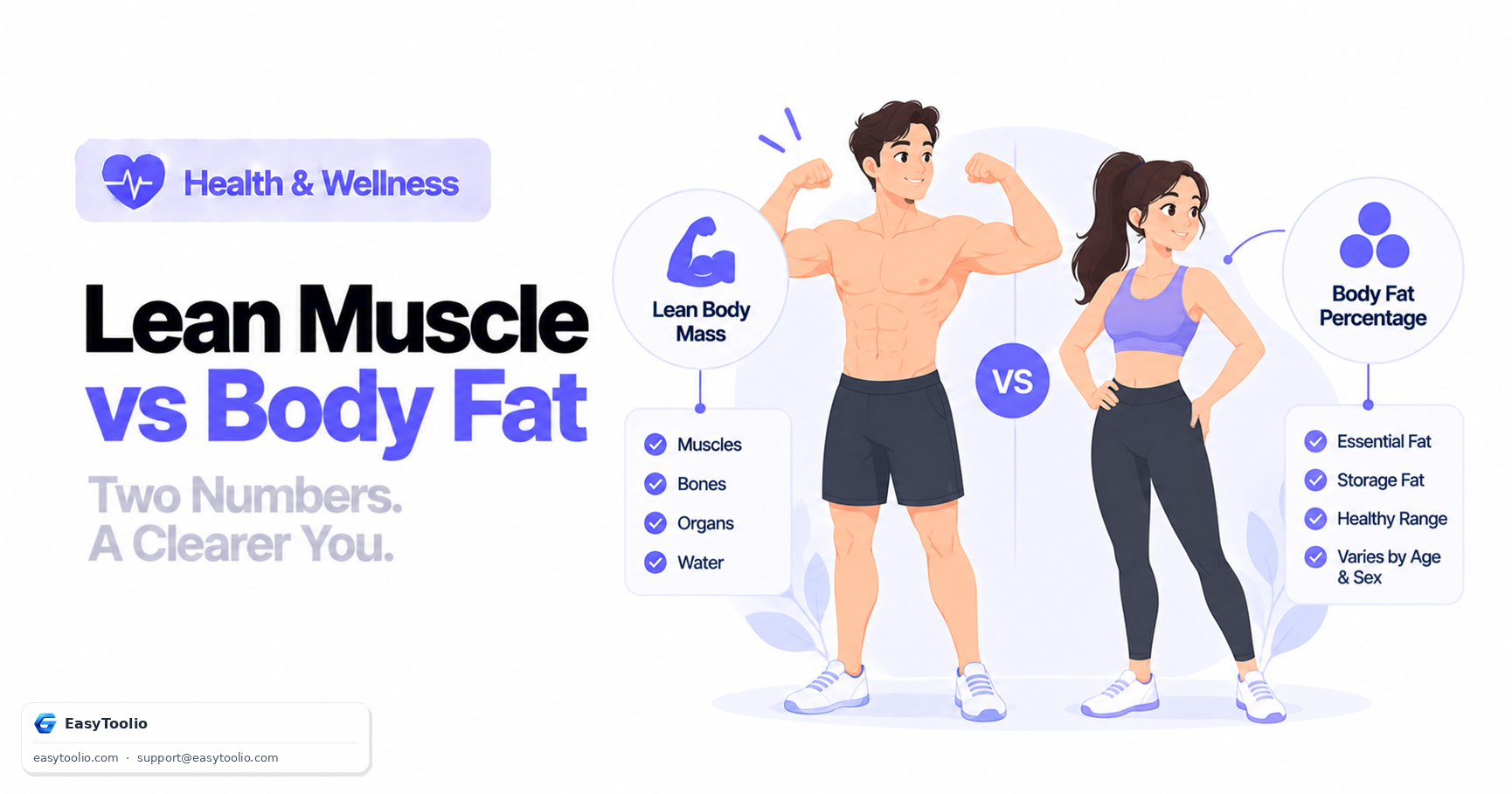
Two people can weigh exactly the same and have wildly different body compositions — one carrying mostly muscle and bone, the other carrying proportionally more fat. Total body weight can't distinguish between them, which is exactly why lean body mass and body fat percentage exist as separate, complementary measurements rather than one replacing the other.
Direct Answer: Lean body mass (LBM) is your total body weight minus fat mass — it includes muscle, bone, organs, and water. Body fat percentage is the proportion of your total weight that is fat tissue. The two are mathematically linked (Body Fat % = Fat Mass ÷ Total Weight × 100, and LBM = Total Weight − Fat Mass), but they answer different questions: body fat percentage tells you how lean or fat you are relative to your size, while lean body mass tells you the absolute amount of metabolically active, protein-dosing-relevant tissue you carry, which matters for things like calculating protein needs or medication dosages that scale to lean tissue rather than total weight.
Common Lean Body Mass Formulas
Several formulas estimate LBM from height, weight, and sex, each developed from different research populations:
| Formula | Male Equation | Female Equation |
|---|---|---|
| Boer (1984) | 0.407 × weight(kg) + 0.267 × height(cm) − 19.2 | 0.252 × weight(kg) + 0.473 × height(cm) − 48.3 |
| James (1976) | 1.10 × weight(kg) − 128 × (weight/height)² | 1.07 × weight(kg) − 148 × (weight/height)² |
| Hume (1966) | 0.3281 × weight(kg) + 0.33929 × height(cm) − 29.5336 | 0.29569 × weight(kg) + 0.41813 × height(cm) − 43.2933 |
These formulas were derived from cadaver studies and population data decades ago, and while they remain in clinical use for their simplicity, they can diverge from more precise methods (DEXA scans, bioelectrical impedance) by a few kilograms depending on an individual's actual muscle-to-fat ratio, especially for very muscular or very high-body-fat individuals who fall outside the populations the formulas were derived from.
Body Fat Percentage: The Other Half of the Picture
Body fat percentage is typically estimated through skinfold measurements (calipers at multiple body sites), bioelectrical impedance (the basis of most smart scales), or circumference-based formulas like the U.S. Navy method, which uses neck, waist, and (for women) hip measurements. None of these are as accurate as a DEXA scan, but they're accessible and useful for tracking relative change over time, even if the absolute number carries some margin of error.
Get your estimated lean body mass with our lean body mass calculator, and cross-check it against your body fat percentage using our body fat calculator for a fuller picture of body composition.
Why Lean Body Mass Matters More Than Total Weight for Certain Calculations
Several important calculations scale to lean tissue specifically, not total body weight, because fat tissue is far less metabolically active:
- Protein requirements: Athletic protein targets (commonly 1.6-2.2g/kg) are more accurately applied to lean body mass than total weight for individuals with higher body fat percentages, since fat tissue doesn't require the same protein support that muscle does.
- Medication dosing: Certain drugs, particularly those that don't distribute well into fat tissue, are dosed by lean body mass or ideal body weight rather than total weight to avoid overdosing in patients with higher body fat.
- Resting metabolic rate: Lean tissue burns substantially more calories at rest than fat tissue does, which is why two people of the same total weight but different body composition can have meaningfully different calorie needs.
- Anesthesia dosing: Many anesthetic drugs are dosed using lean body mass formulas specifically because fat tissue poorly absorbs certain lipophilic and hydrophilic drug classes differently, and total-weight-based dosing can be inaccurate in patients with higher adiposity.
Healthy Body Fat Percentage Ranges by Sex and Age
| Category | Men (Age 20-39) | Men (Age 40-59) | Women (Age 20-39) | Women (Age 40-59) |
|---|---|---|---|---|
| Essential fat | 2-5% | 2-5% | 10-13% | 10-13% |
| Athletes | 6-13% | 8-15% | 14-20% | 15-22% |
| Fitness | 14-17% | 15-19% | 21-24% | 23-27% |
| Acceptable/Average | 18-24% | 20-26% | 25-31% | 28-33% |
| Above average / Obesity range | 25%+ | 27%+ | 32%+ | 34%+ |
These ranges (adapted from commonly cited American Council on Exercise classifications) shift with age because body composition naturally trends toward higher fat and lower muscle mass over time even at stable total weight, absent resistance training and adequate protein intake.
How to Use Both Numbers Together
Tracking only body weight hides what's actually changing underneath — a person losing fat while gaining muscle through resistance training might see the scale barely move, while their body fat percentage drops and their lean body mass rises, which is a genuinely positive outcome the scale alone would misread as "no progress." Reviewing LBM and body fat percentage together, ideally every 4-8 weeks rather than daily, gives a far more accurate read on whether a fitness or nutrition program is working.
Frequently Asked Questions
Can I lose fat and gain muscle at the same time?
Yes, this is possible, particularly for beginners to resistance training, people returning after a long break, or those in a moderate calorie surplus with adequate protein and progressive strength training — it's commonly called "body recomposition." It becomes progressively harder for trained individuals to achieve simultaneously as they approach their genetic muscle-building ceiling.
Is a bioelectrical impedance scale accurate for body fat percentage?
It's reasonably useful for tracking your own trend over time under consistent conditions (same time of day, hydration level, and scale), but it can be off by several percentage points in absolute accuracy compared to a DEXA scan, since hydration status significantly affects the electrical signal the scale measures.
Does lean body mass include water weight?
Yes — lean body mass includes all non-fat tissue, which is roughly 70-75% water by composition (muscle, organs, and bone all contain substantial water). This is part of why LBM can fluctuate slightly day to day with hydration status, separate from any actual change in muscle tissue.
What's a healthy body fat percentage to aim for?
This depends heavily on individual goals, sex, and age — the "fitness" and "acceptable" ranges in the table above represent healthy targets for most non-athletes, while going below the "essential fat" range for extended periods can be genuinely harmful to hormonal and organ function.
Why do bodybuilders care about lean body mass more than total weight?
Because their goal is maximizing muscle tissue specifically, not maximizing total body weight — a bodybuilder gaining 5kg of fat and losing 2kg of muscle would see total weight go up while lean body mass goes down, which represents the opposite of their actual training goal.
This information is provided for general educational purposes and is not a substitute for professional medical or nutritional advice.
References: American Council on Exercise (ACE) body fat percentage categorization; Boer P. (1984), "Estimated lean body mass as an index for normalization of body fluid volumes in humans," American Journal of Physiology.