
"Cut 500 calories a day and lose a pound a week" is one of the most repeated rules in fitness. It's a useful starting estimate, but the math behind it is far simpler than the way the human body actually responds to a sustained calorie deficit.
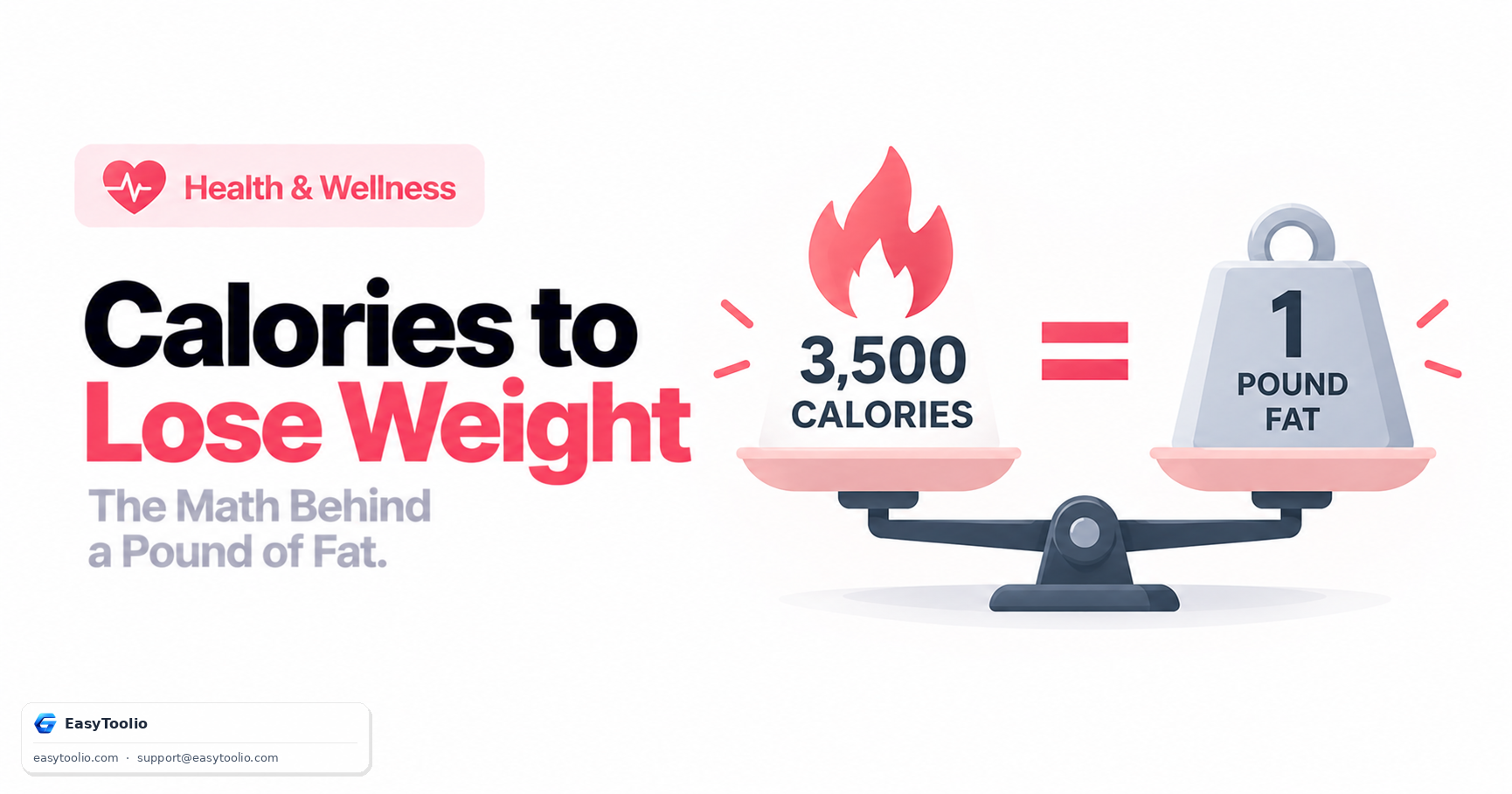
Direct Answer: The commonly cited rule that 3,500 calories equal approximately one pound of body fat comes from Max Wishnofsky's 1958 estimate of the caloric energy density of adipose tissue. It's a useful planning approximation, not a precise clinical constant: real-world weight change also involves water-weight fluctuation, changes in lean mass alongside fat mass, and metabolic adaptation, so weight loss over time is not a perfectly linear function of a fixed calorie deficit.
Health & Medical Disclaimer: Calorie deficit estimates in this article are general planning tools, not medical advice. They are not intended for individuals with a history of disordered eating, and anyone pursuing significant or rapid weight change should consult a physician or registered dietitian.
1. Where the 3,500-Calorie Rule Comes From
1 lb of body fat ≈ 3,500 kcal
This figure traces back to Wishnofsky's 1958 estimate of the energy density of human adipose tissue. From it, a simple weekly deficit target follows:
Daily Deficit Needed = 3,500 kcal ÷ 7 days = 500 kcal/day for ~1 lb/week
Worked Example
A person with a TDEE of 2,400 kcal/day aiming to lose roughly 1 lb per week:
Target Daily Deficit: 500 kcal
New Daily Calorie Target: 2,400 − 500 = 1,900 kcal/day
Projected Weekly Loss: ~1 lb (as a starting estimate)
2. Why the Rule Is a Simplification, Not a Precise Constant
Several well-documented factors mean real-world results diverge from the simple 3,500-calorie math over time:
- Metabolic Adaptation: As body weight decreases, TDEE itself decreases too — a lighter body generally burns somewhat fewer calories at rest and during activity, meaning the same fixed 500-calorie cut produces a shrinking effective deficit as weight drops, unless intake or activity is adjusted.
- Water Weight Fluctuation: Glycogen stores hold water alongside them (roughly 3 grams of water per gram of stored glycogen), so early rapid weight loss in a new deficit is often disproportionately water weight rather than fat, which can make week-one results look better than the calorie math alone would predict.
- Changes in Lean Mass: A calorie deficit can reduce some lean muscle mass alongside fat mass, especially without adequate protein intake or resistance training, and lean tissue is metabolically different from fat tissue.
- Non-Linear Trajectory: More recent modeling research (building on the fixed 3,500-calorie rule) shows that weight loss traces a curve that flattens over time rather than a straight line, since the body's own expenditure adjusts downward as weight is lost.
3. Practical Framing: Set a Sustainable Deficit Off TDEE
Rather than chasing an exact daily number, a more practical approach is to:
- Establish a realistic TDEE baseline (via a calculator or a few weeks of tracked intake against actual weight trend).
- Apply a moderate deficit (commonly in the range of roughly 10–25% below TDEE) rather than an aggressive one.
- Re-check the trend every few weeks and adjust the target, since TDEE itself shifts as weight changes.
- Treat the 3,500-calorie figure as a rough planning tool for setting an initial target, not a precise formula that guarantees an exact result on a given day.
Estimate your calorie deficit target with our calorie-calculator, establish your baseline TDEE using tdee-calculator, and account for exercise-day calories burned with calories-burned-calculator.
4. Aggressive Deficits vs. Moderate Deficits
Because the 3,500-calorie figure is linear and easy to multiply, it's tempting to assume that doubling the daily deficit simply doubles the rate of fat loss. In practice, very large deficits carry trade-offs that a spreadsheet calculation doesn't capture:
| Deficit Size | Typical Daily Cut | Common Trade-Off |
|---|---|---|
| Conservative | ~10–15% below TDEE | Slower visible progress, but generally easier to sustain and more likely to preserve lean mass |
| Moderate | ~15–25% below TDEE | A commonly recommended middle ground for steady, sustainable progress |
| Aggressive | 30%+ below TDEE | Higher risk of muscle loss, fatigue, and a larger metabolic slowdown, making the deficit harder to sustain over time |
There is no single deficit size that's correct for everyone — starting point, activity level, and how sustainable a given restriction feels in daily life all factor into what a workable number looks like in practice.
5. Frequently Asked Questions (FAQs)
Is 3,500 calories per pound scientifically exact?
No — it's a widely used estimate of the energy density of fat tissue from Wishnofsky's 1958 work, useful for rough planning, but not a precise clinical constant that applies identically to every individual and every stage of a diet.
Why did I lose more weight in week one than the calorie math predicted?
Early weight loss in a new calorie deficit is often driven substantially by water weight lost alongside depleted glycogen stores, not fat alone. This effect typically fades after the first one to two weeks, after which the rate of loss tends to better reflect the underlying calorie deficit.
Why does weight loss slow down even if I keep the same calorie deficit?
As body weight drops, TDEE tends to drop with it, since a lighter body generally requires less energy for both resting metabolism and daily movement. A fixed 500-calorie cut calculated against your starting TDEE becomes a smaller effective deficit as weight decreases, which is why periodically recalculating TDEE against current weight is a standard part of a sustainable plan.
Does the 3,500-calorie rule work the same way for a calorie surplus and muscle gain?
The same basic energy-balance logic applies in reverse for weight gain, but the composition of gained weight (muscle vs. fat) depends heavily on factors the calorie math alone doesn't capture, such as resistance training and protein intake. A surplus without training generally results in more fat gain relative to muscle than the same surplus paired with a structured strength program.
References: Wishnofsky M (1958) — the 3,500-calorie-per-pound estimate of adipose tissue energy density.