Two women can each be trying to identify their fertile window and end up using methods that answer completely different questions — one predicts a window in advance based on cycle history, the other confirms, after the fact, that ovulation has already happened. Knowing which method does which is the difference between using them well together and being confused when they don't seem to agree.
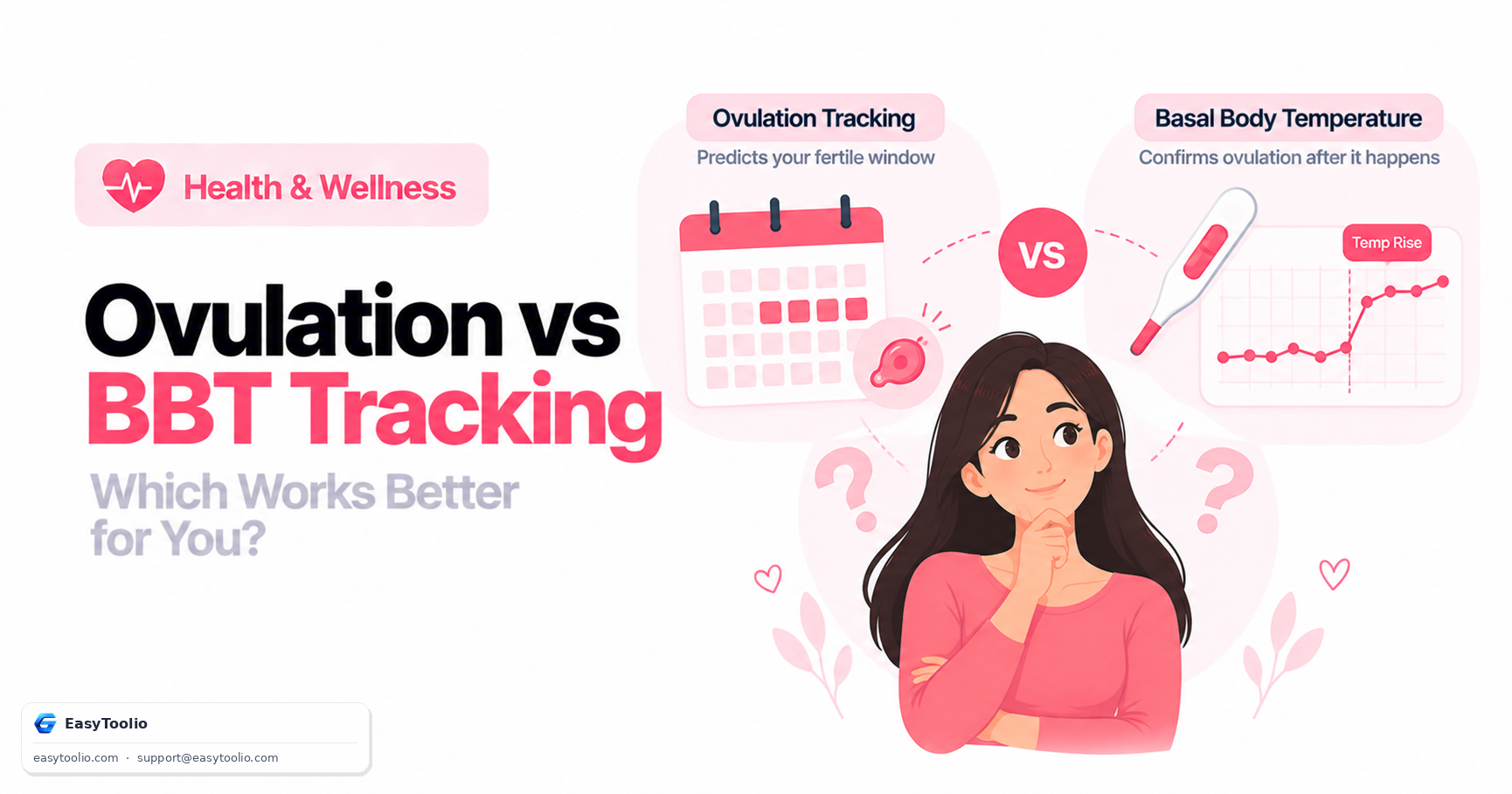
Direct Answer: Calendar/cycle-length based ovulation prediction estimates a fertile window in advance by counting forward from the start of your period, typically placing ovulation around 14 days before the next expected period in an average cycle — useful for planning ahead, but only an estimate based on cycle regularity. Basal body temperature (BBT) charting confirms that ovulation has already occurred by detecting a sustained temperature rise of about 0.5-1°F caused by increased progesterone after the egg is released — accurate as confirmation, but retrospective rather than predictive. Combining a calendar-based ovulation calculator with BBT charting (and ideally cervical mucus observation) is more reliable than relying on either method alone, since one predicts forward and the other confirms backward.
How Calendar-Based Ovulation Prediction Works
This method estimates the fertile window using the length of your menstrual cycle, based on the fact that ovulation typically occurs about 14 days before the next period begins (the luteal phase — the time from ovulation to the next period — tends to be relatively consistent at 12-16 days for most people, even when the follicular phase before ovulation varies more).
Worked example: For someone with a consistent 28-day cycle, ovulation is estimated around day 14, with a fertile window commonly estimated as the 5 days before ovulation plus the day of ovulation itself (since sperm can survive several days, but the egg is viable for roughly 12-24 hours after release).
The core limitation: this method is a forward-looking estimate based on your cycle history. It works best for people with regular, predictable cycles, and becomes progressively less reliable for anyone with irregular cycles, since it's essentially averaging past patterns to predict a future date rather than detecting ovulation as it happens.
How Basal Body Temperature (BBT) Charting Works
BBT is your body's temperature at complete rest, measured immediately upon waking, before any activity (including talking, sitting up, or drinking water) raises it even slightly. The method relies on a well-documented hormonal mechanism: after ovulation, rising progesterone levels cause a sustained increase in basal body temperature of roughly 0.5-1°F (about 0.3-0.6°C), which persists until the next period (or continues if pregnancy occurs).
How the confirmation works in practice:
- Take your temperature at the same time every morning, before getting out of bed, using a basal thermometer (which measures in finer increments than a standard fever thermometer).
- Chart the readings daily across the cycle.
- Look for a sustained rise (not just one higher reading, but a shift that holds for several consecutive days) of about 0.5-1°F compared to the pre-ovulation baseline.
- That sustained rise confirms ovulation already occurred, typically 1-2 days prior to when the temperature shift becomes clearly visible on the chart.
The core limitation here is timing: BBT confirms ovulation has already happened rather than predicting it in advance, so by the time the temperature shift is visible, the most fertile part of the window (in the days just before and during ovulation) has often already passed for that cycle.
Comparing the Two Methods
| Method | What It Detects | Timing | Best Used For |
|---|---|---|---|
| Calendar/cycle-length prediction | Estimated future fertile window | Predictive (before ovulation) | Planning ahead, especially with regular cycles |
| Basal body temperature (BBT) | Confirmed past ovulation via temperature rise | Retrospective (after ovulation) | Confirming ovulation occurred, understanding personal cycle patterns over time |
Why Combining Methods (Plus Cervical Mucus) Beats Either Alone
Because calendar prediction looks forward and BBT confirms backward, using them together closes the gap each one leaves open on its own:
- Calendar prediction gives an advance estimate of when to expect the fertile window, useful for planning.
- BBT confirms, cycle after cycle, whether ovulation is actually happening on roughly the pattern the calendar method assumes — which also helps validate (or correct) the calendar estimate over several months of tracking.
- Cervical mucus observation adds a third, real-time signal: mucus typically becomes clear, stretchy, and egg-white-like in the days immediately before ovulation, which — unlike BBT — can help identify the fertile window as it's approaching rather than only after it has passed.
Many fertility awareness practitioners consider the combination of all three (sometimes called the symptothermal method) meaningfully more reliable than any single method alone, precisely because each compensates for what the others miss.
A Note on Accuracy and When to Seek Additional Guidance
This content is informational and intended to explain how these tracking methods work — it is not a substitute for guidance from a fertility specialist or OB-GYN, particularly for anyone with irregular cycles, a known fertility condition, or who has been trying to conceive for an extended period without success. A specialist can also offer more precise confirmation methods, such as ovulation predictor kits that detect the LH hormone surge, or clinical monitoring.
Frequently Asked Questions
Which method is more accurate for identifying the fertile window in advance?
Calendar-based prediction is the only one of the two that estimates the window in advance, but its accuracy depends heavily on cycle regularity. BBT is more accurate as confirmation but only after the fact, so it doesn't help predict the window ahead of time on its own.
How much does basal body temperature actually rise after ovulation?
Typically about 0.5-1°F (roughly 0.3-0.6°C), sustained for several consecutive days rather than a single reading, caused by increased progesterone following ovulation.
Can I use BBT charting if my cycles are irregular?
Yes — BBT charting can still confirm ovulation on irregular cycles since it detects an actual hormonal event rather than relying on a predicted date, which is part of why it's often recommended specifically for people whose calendar-based predictions have proven unreliable.
Do I need special equipment for BBT charting?
A basal body thermometer (which measures to two decimal places, unlike most standard fever thermometers) is recommended for the precision needed to detect the relatively small 0.5-1°F shift reliably.
Is tracking ovulation useful for avoiding pregnancy as well as achieving it?
Fertility awareness methods, including calendar and BBT tracking, can be used for either goal, but using them reliably to avoid pregnancy generally requires more rigorous, consistent tracking (often combined with cervical mucus observation) and carries a higher user-error failure rate than most clinical contraceptive methods, so anyone relying on it for pregnancy avoidance should get guidance from a healthcare provider on proper technique.
References: American College of Obstetricians and Gynecologists (ACOG) guidance on fertility awareness methods; Mayo Clinic guidance on ovulation and basal body temperature tracking.