
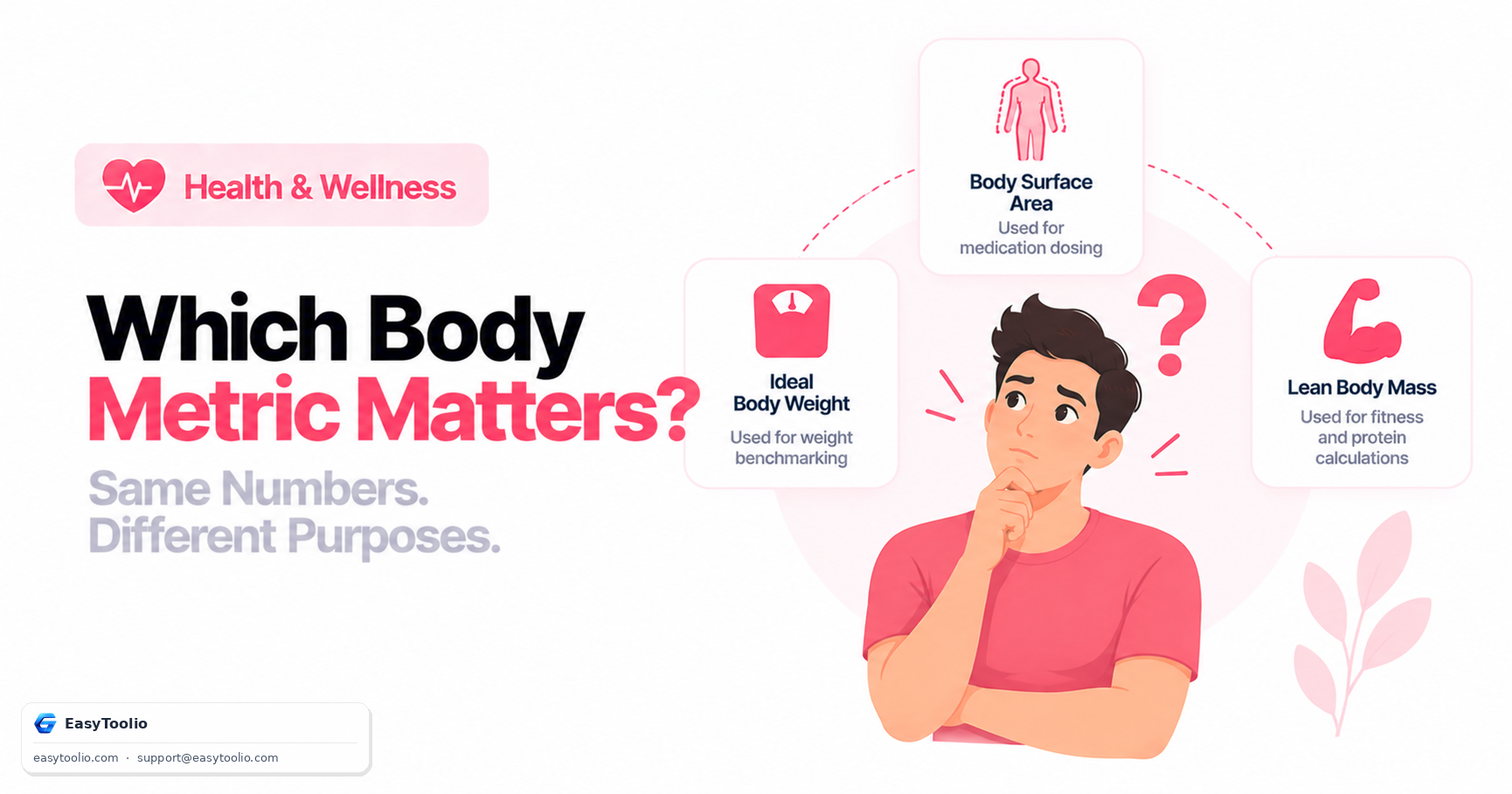
Type "body weight formula" into any calculator directory and you'll find body surface area, ideal body weight, and lean body mass sitting next to each other as if they're three versions of the same idea. They aren't. Each one was designed decades ago to solve one specific clinical or practical problem, and using one formula's result for a purpose it was never built for is a genuinely common mistake — including, occasionally, in real clinical settings.
Direct Answer: Body surface area (BSA), calculated via formulas like Mosteller or DuBois from height and weight, is used primarily for medication dosing (especially chemotherapy) and burn injury assessment, because drug clearance and fluid loss correlate more closely with body surface area than with weight alone. Ideal body weight (IBW), via formulas like Devine, Robinson, or Miller, is a rough population-average weight target based on height and sex, historically used for drug dosing calculations and as a general reference point, not a personal "goal weight." Lean body mass (LBM) estimates the weight of everything in your body that isn't fat — muscle, bone, organs, water — and is used mainly in fitness and nutrition contexts to guide protein intake and track body composition changes. None of these three numbers substitutes for either of the other two, and none of this is a substitute for personalized guidance from a physician, dietitian, or pharmacist.
What Each Formula Actually Measures
| Metric | What It Estimates | Primary Real-World Use | NOT Meant For |
|---|---|---|---|
| Body Surface Area (BSA) | Total external surface area of the body (m²) | Chemotherapy and other drug dosing; burn injury % assessment | Judging healthy weight or body composition |
| Ideal Body Weight (IBW) | A population-average reference weight for a given height/sex | Historical drug dosing calculations (e.g., certain antibiotics); rough benchmark | A personal weight-loss target or fitness goal |
| Lean Body Mass (LBM) | Total body weight minus estimated fat mass | Protein intake targets; tracking body composition change over time | Diagnosing obesity or a single "healthy weight" number |
Body Surface Area: Why Drug Dosing Uses It
The Mosteller formula, one of the most widely used in clinical practice for its simplicity, is:
BSA (m²) = √[ (Height in cm × Weight in kg) / 3600 ]
The DuBois formula, older and still used in some contexts, is:
BSA (m²) = 0.007184 × Height(cm)^0.725 × Weight(kg)^0.425
BSA correlates well with metabolic rate, cardiac output, and kidney function — all of which affect how quickly a drug is processed and cleared from the body — which is why chemotherapy dosing in particular is calculated per square meter of BSA rather than simply per kilogram of body weight. It's also the standard metric for estimating the percentage of body surface affected by a burn injury, which directly informs fluid resuscitation calculations in emergency care. Estimate your own BSA using our body surface area calculator — but note that actual medication dosing must always be confirmed by a qualified clinician, not a self-service tool.
Ideal Body Weight: A Reference Point, Not a Target
The Devine formula, one of the most commonly cited, is:
Men:   IBW (kg) = 50 + 2.3 × (height in inches over 60)
Women: IBW (kg) = 45.5 + 2.3 × (height in inches over 60)
This formula was originally developed in the 1970s specifically to standardize drug dosing calculations for certain medications, not to define a personal health or aesthetic goal. It uses height and sex only — no frame size, muscle mass, or body composition — which is exactly why it produces a single number that doesn't account for the enormous natural variation between two people of the same height. Use our ideal weight calculator as a rough population reference point, not as a number to chase, since a muscular, athletic individual and a sedentary individual of the same height can have dramatically different healthy weights that a single formula can't distinguish.
Lean Body Mass: The Fitness and Nutrition Number
Lean body mass formulas, such as Boer or Hume, estimate everything in the body except fat mass:
Boer (men):   LBM = 0.407 × weight(kg) + 0.267 × height(cm) − 19.2
Boer (women): LBM = 0.252 × weight(kg) + 0.473 × height(cm) − 48.3
LBM is the number most relevant to two very practical, non-clinical goals: setting a protein intake target (commonly recommended in grams per kilogram of lean body mass rather than total body weight, since fat tissue doesn't require the same protein support as muscle) and tracking body composition changes over time — a person can lose fat and gain muscle simultaneously, showing little change on a bathroom scale while their LBM and fat mass shift meaningfully in opposite directions. Estimate yours with our lean body mass calculator to get a starting point for nutrition planning.
The Common Mistake: Using One Formula's Output for the Wrong Purpose
- Using ideal body weight as a personal goal weight ignores muscle mass, bone density, and frame size entirely — an athlete can weigh well above their "ideal weight" formula result while being lean and healthy.
- Using lean body mass as a total dosing reference for medications is generally inappropriate outside of the very specific drugs where clinicians intentionally dose on LBM (some anesthesia and certain drugs with limited fat distribution) — most medication dosing uses actual body weight or BSA, not LBM.
- Using BSA as a general health or weight indicator misses the point of the formula entirely — it says nothing about body composition, only about total surface area for dosing and fluid purposes.
The three formulas are not competing methods for the same question — they're each the correct tool for a different, specific question, and mixing them up is where confusion (and, in clinical contexts, genuine dosing risk) creeps in.
Frequently Asked Questions
Which of these three numbers should I actually care about day to day?
For most people focused on fitness or nutrition, lean body mass is the most practically useful of the three, since it directly informs protein targets and helps interpret body composition changes better than total weight alone. BSA and IBW are more relevant in specific clinical dosing contexts than everyday tracking.
Is ideal body weight the same as a "healthy BMI weight range"?
No — they're calculated differently and serve different purposes. IBW formulas use only height and sex to produce a single reference number; BMI-based healthy weight ranges use height and weight together to produce a range, and neither accounts for body composition or muscle mass.
Why does chemotherapy dosing use BSA instead of just body weight?
Because drug clearance rates correlate more closely with metabolic rate and organ function, which scale more closely with body surface area than with weight alone — this makes BSA-based dosing more consistent across patients of different body types than simple per-kilogram dosing would be.
Can I lose weight on the scale without changing my lean body mass much?
Yes — if weight loss comes primarily from fat loss while muscle mass is maintained (common with adequate protein intake and resistance training during a calorie deficit), lean body mass can stay relatively stable even as total body weight and fat mass decrease.
Are these formulas accurate for everyone, including children and the elderly?
Most of these formulas were validated primarily on adult populations and may be less accurate for children, adolescents, elderly individuals, or those with atypical body composition (very high muscle mass, amputation, edema). Clinical calculations for these groups typically use adjusted or alternative formulas under professional supervision.
References: Mosteller, R.D. (1987), "Simplified Calculation of Body-Surface Area," New England Journal of Medicine; Devine, B.J. (1974) ideal body weight formula; Boer, P. (1984) lean body mass formula; general clinical pharmacology dosing literature.