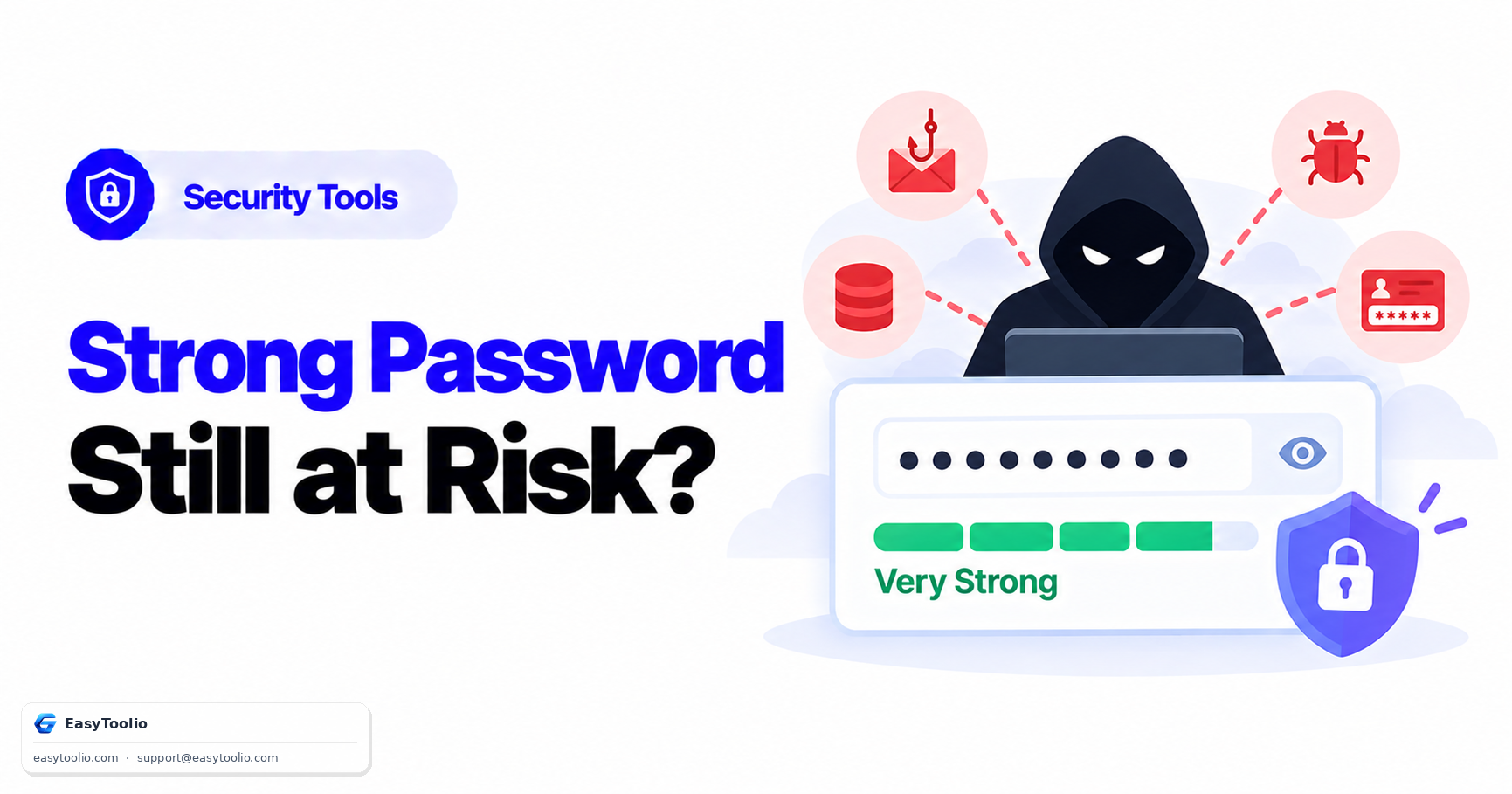
Someone builds a 16-character password with symbols, numbers, and mixed case, runs it through a strength checker, gets a green "Very Strong" rating — and six months later their account shows up in a breach notification anyway. It feels like a contradiction. The password was strong. The checker said so. So why didn't strength save the account?
Direct Answer: A password strength checker can only evaluate one thing: how resistant a password's characters and structure are to offline guessing attacks like brute force and dictionary matching, based on its length, character variety, and whether it matches patterns from known-leaked password lists. It has zero visibility into how the password is used or stored elsewhere — it cannot detect that the same strong password was reused on a different site that later got breached, cannot stop a phishing page from simply asking the user to type it in voluntarily, cannot detect keyloggers or malware capturing keystrokes as they're typed, and cannot see whether the site on the receiving end stores that password in plaintext or with weak hashing regardless of how strong the input was. Strength is necessary but nowhere near sufficient; tools like the password strength checker, password generator, and hash generator each address a different narrow piece of a much larger security picture.
What a strength score is actually computing
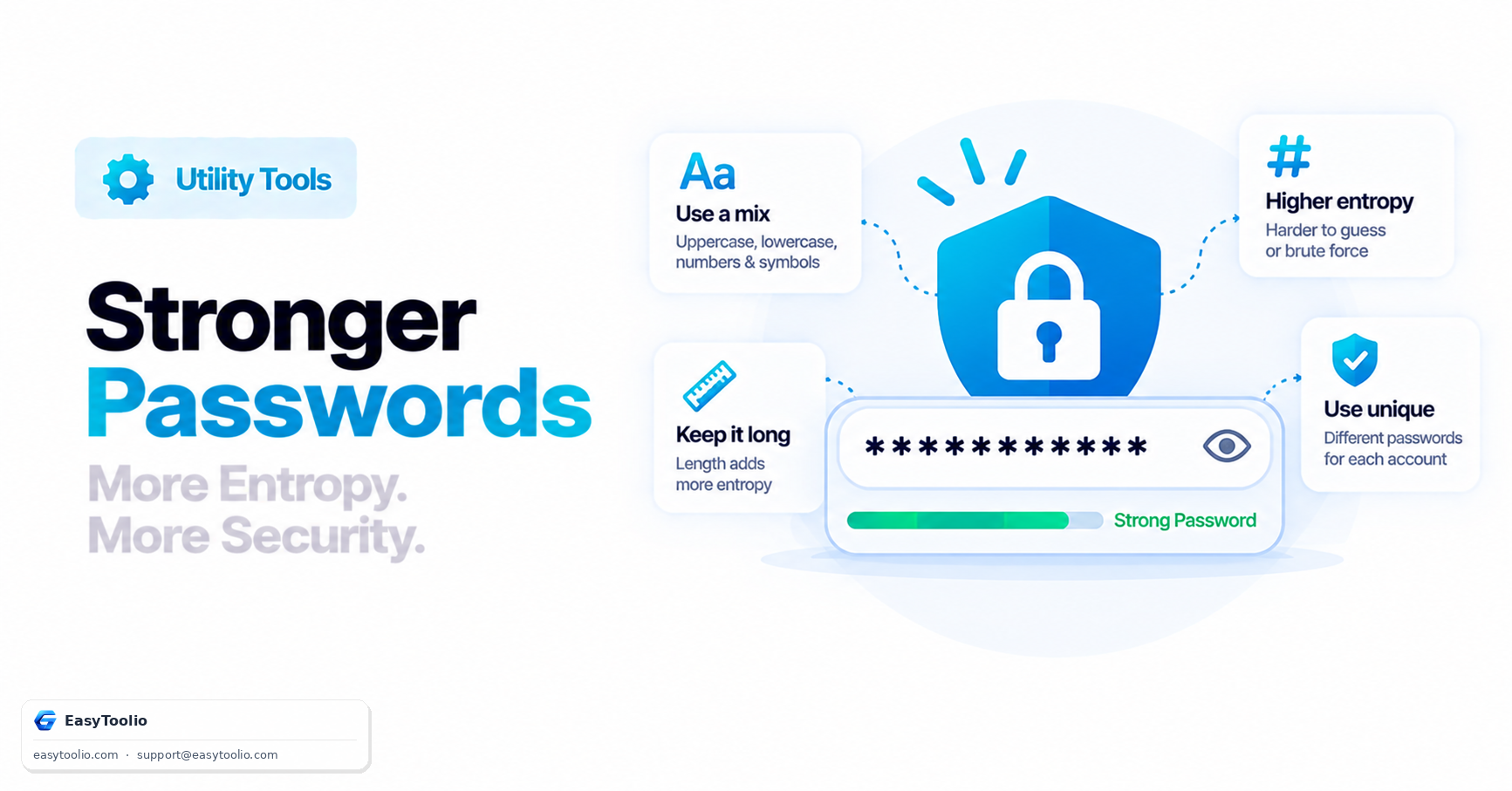
A strength checker takes the string you typed and runs a handful of local calculations against it:
- Length and character-set size — more possible characters per position and more positions means a larger theoretical keyspace an attacker would have to search.
- Entropy estimate — a rough measure of how unpredictable the password is, assuming an attacker has to guess randomly across that keyspace.
- Pattern and dictionary matching — checking the password against common substitutions ("P@ssw0rd1"), keyboard walks ("qwerty123"), and lists of passwords already known from previous breaches.
All of this happens on the string in isolation, with no knowledge of anything outside it. It's answering exactly one question: "if an attacker had to guess this password character by character or against known weak patterns, how long would that take?" That's a real and useful question — it's just a much narrower question than "will this account get compromised?"
The attack surface a strength score cannot see
                    STRENGTH CHECKER'S VIEW
                    ┌─────────────────────┐
                    │   the password       │
                    │   string itself      │
                    └─────────────────────┘
                              |
        ────────────────────────────────────────────
                              |
   Everything below happens OUTSIDE the string it sees:

   [Credential reuse]   same strong password, different site,
                         one of them gets breached -> both compromised

   [Phishing]            user is tricked into typing the strong
                         password into a fake login page voluntarily

   [Keyloggers/malware]  password captured as it's typed, regardless
                         of how "strong" the characters are

   [Server-side storage] site stores it in plaintext or with weak/no
                         hashing -> a breach exposes it either way
Each of these bypasses the password's strength entirely rather than defeating it through guessing.
Credential reuse: strength doesn't stop the same key opening two doors
If you generate one excellent 20-character password and use it on both your email and a small forum, the forum's security is now effectively your email's security too. When that forum gets breached — and smaller, less-resourced sites get breached constantly — the leaked credential list gets tested against other services in what's called credential stuffing. The password itself was never guessed or brute-forced; it was simply typed in somewhere else and copied out. This is precisely why a password generator is meant to be paired with using a unique password per site, not just a strong one.
Phishing sidesteps guessing entirely
A phishing page doesn't need to break your password's math at all — it just needs you to type it into a form that looks like the real login page. From the attacker's perspective, a 30-character random password and "password123" are equally easy to obtain if the user hands it over willingly to a convincing fake. Strength has no bearing on social engineering resistance.
Malware captures keystrokes, not entropy
A keylogger or clipboard-monitoring malware on a compromised device records exactly what you type or paste, character for character, regardless of how unpredictable that sequence would be to a remote guessing attack. The strength score describes resistance to a mathematical guessing process; it says nothing about the security of the device the password is typed on.
The server side is entirely outside the password's control
Even a perfectly strong, perfectly unique, never-phished password can be exposed if the receiving service stores passwords carelessly — in plaintext, or hashed with an outdated algorithm without proper salting. Responsible services hash passwords with slow, salted algorithms designed to resist offline cracking even if the database leaks; a hash generator is a useful way to see conceptually how hashing transforms input data, though production password storage requires purpose-built algorithms (like bcrypt or Argon2) rather than a general-purpose hash function. None of this is visible to, or controllable by, the strength of the password a user chose.
What strength scoring is genuinely good for
None of this means strength checkers are pointless — they correctly rule out one entire category of attack (offline brute-force and dictionary guessing) that remains common against weak, reused, or pattern-based passwords. The mistake is treating a high score as a security guarantee rather than as one solved problem among several unrelated ones.
Frequently Asked Questions (FAQs)
If my password is rated "very strong," am I safe from being hacked?
No. You're specifically resistant to offline brute-force and dictionary guessing attacks. You remain exposed to reuse across breached sites, phishing, malware on your device, and poor password storage practices on the service's end — none of which a strength score evaluates.
Does using a password generator fix all of this?
It fixes the strength and uniqueness dimension well, especially combined with a password manager so each generated password is only ever used on one site. It does not protect against phishing or malware, which require separate defenses like multi-factor authentication and endpoint security.
Why do security experts still recommend strong passwords if they don't stop most breaches?
Because a weak, guessable password is still trivially exploitable and remains one of the most common initial entry points, especially against services without rate-limiting or lockout protections. Strength is a baseline requirement, not a complete defense — it removes one attack path so that the remaining ones (reuse, phishing, MFA gaps) become the actual determining factors.
Reference: NIST Special Publication 800-63B, Digital Identity Guidelines — Authentication and Lifecycle Management.