Notification
Go to Home All Tools Compare Glossary Blog Contact

Password Strength Checker

Check how strong your password is, see its estimated crack time, and get tips to fix weak patterns, all analyzed locally in your browser.

Local Analysis Policy
Read policy
All analysis is performed 100% locally in your browser. Passwords are never sent over the network, stored, or logged on our servers.

Enter Password to Test

Security Heuristics Checklist

Minimum Length (12+)
Not Common Password
No Dictionary Words
No Repeated Characters
No Weak Sequences
Mix of Character Types

Security Recommendations

Type a password in the input field above to see tailored recommendations.

Security Score

0 out of 100
Empty Password

Strength classification is calculated dynamically using entropy and weak pattern deductions.

Security Indicators

Length 0 chars
Entropy 0 bits
Estimated Crack Time 0 seconds

Character Analysis

Uppercase Letters (A-Z) 0
Lowercase Letters (a-z) 0
Numbers (0-9) 0
Special Symbols (!@#...) 0
Interactive Examples

Common Password Structures Compared

Weak

123456

A basic consecutive sequence. Cracking tools recognize numerical runs instantly. Highly susceptible to dictionary/brute-force attacks.

Medium

Yellowstone99!

Combines a capitalized dictionary word, numbers, and a symbol. While better, the predictable sequence of word-number-symbol is vulnerable to hybrid attacks.

Very Strong

K#7xN$2mR@9qW

A completely randomized sequence of mixed casing letters, digits, and special symbols. No recognizable vocabulary or keyboard walks.

Password Security Education

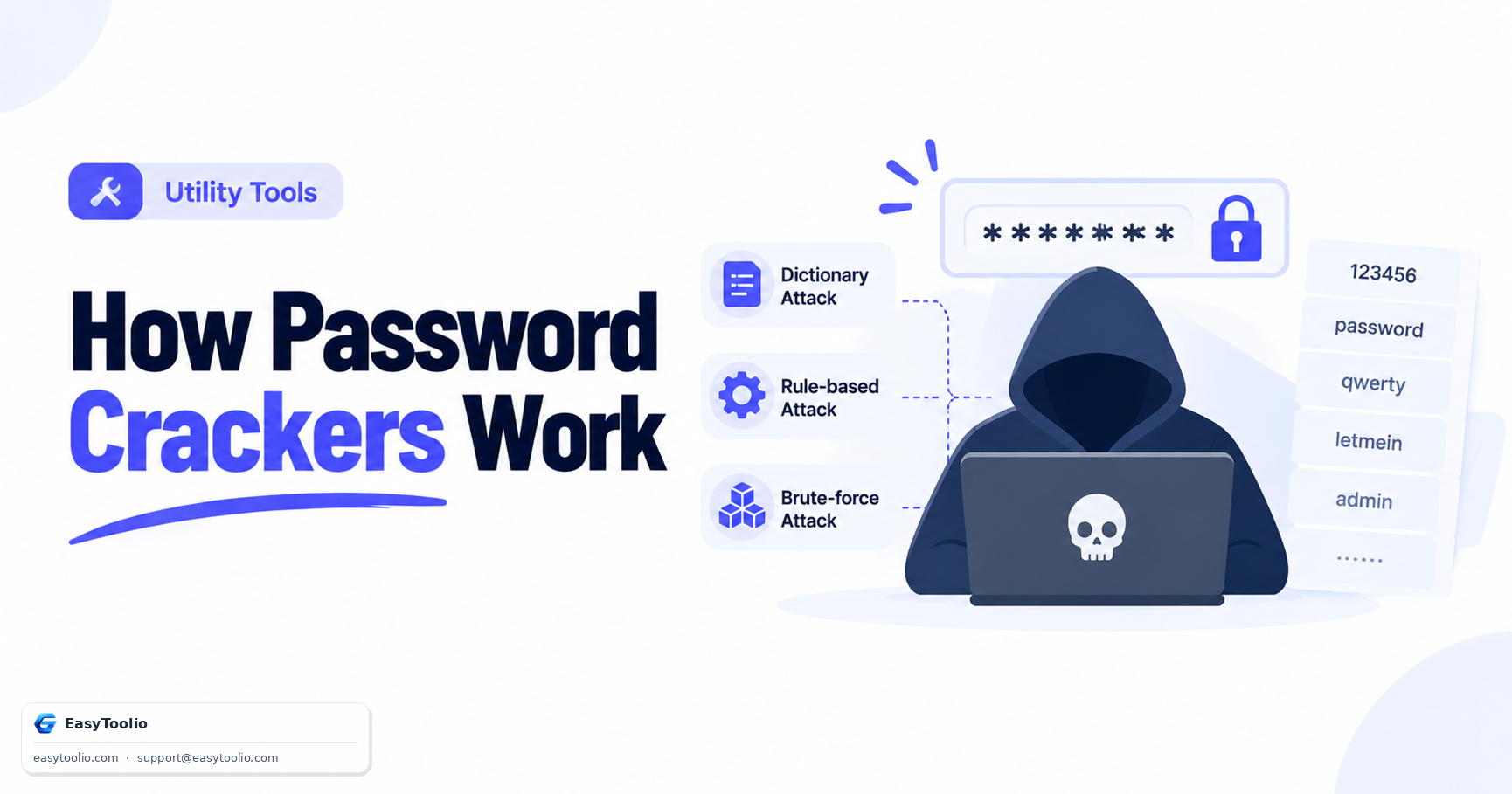
Brute-Force Attacks: Automated software guesses every possible combination of letters, numbers, and symbols until it finds the correct one. The longer and more varied your password is, the longer this process takes (growing exponentially).

Dictionary Attacks: Rather than guessing randomly, attackers use precompiled lists of words, common passwords, and variations (like swapping 'e' for '3'). If your password contains simple dictionary words or names, it will likely be cracked in seconds.

Credential Stuffing: When a website is breached, lists of usernames and passwords are leaked. Attackers feed these leaked credentials into automated bots to log into thousands of other popular websites. Never reuse passwords!

Ultimate Account Protection Checklist

  • Enable Multi-Factor Authentication (MFA/2FA)

    Always enable 2FA using authenticator apps (Google Authenticator, Aegis) or physical security keys (YubiKey).

  • Use a Premium Password Manager

    Store complex, generated passwords in encrypted digital vaults like Bitwarden, 1Password, or Proton Pass.

  • Perform Regular Audits

    Periodically audit your password manager vaults to identify leaked, weak, or duplicated credentials and update them.

Deep Dive Guide: How Password Security and Entropy Work

How password complexity differs from randomness

A password like P@$$w0rd123! appears complex to the human eye because it uses symbols, numbers, and capital letters. However, because it matches a standard pattern (the word "password" with basic substitutions and suffixing), it is highly predictable to cracking software. True password security relies on randomness, which makes the character distribution unpredictable.

What is Entropy in password security?

In information theory, entropy calculates how much uncertainty exists in a given dataset. For passwords, it is calculated in bits using the equation: Entropy = L * log2(R), where L is the character length and R is the size of the set from which characters are drawn (e.g. 26 for lowercase, 52 for mixed case, 62 for alphanumeric, 94 for all ASCII characters). Higher entropy represents exponentially larger combinations, meaning a password with 80 bits of entropy is 1 million times harder to crack than one with 60 bits.

Local-only evaluation and browser privacy

Evaluating password strength on a server requires sending the raw characters over the network. If the connection is insecure or the server keeps logs, your password could be exposed. By utilizing client-side JavaScript, our Password Strength Checker processes all character indices, runs local dictionary scans, and computes cryptographic entropy exclusively inside your browser's sandboxed environment. Nothing ever leaves your device.

Education

How Password Entropy and Scoring Work

01

What Entropy Measures

Entropy measures how unpredictable a password is, expressed in bits, using the formula length multiplied by log2 of the character pool size in use (26 for lowercase letters alone, growing toward roughly 95 once uppercase letters, numbers, and symbols are all combined). This checker calculates entropy directly from the character types actually present, then combines it with length to produce an overall 0 to 100 security score. Higher entropy means exponentially more combinations an attacker would need to try.

02

Why Length Outweighs Complexity Alone

A short password packed with symbols can still carry lower entropy than a longer, simpler one, because entropy grows with length multiplicatively while adding another character type only multiplies the pool size by a fixed amount. The checker also deducts points for weak patterns such as repeated characters, keyboard walks like qwerty, sequential digits like 12345, and dictionary words, since these are the first patterns any automated cracking tool tries regardless of raw entropy.

03

Comparing Weak, Medium, and Strong Passwords

A password such as 123456 has almost no entropy and is cracked instantly because it sits at the top of every breach dictionary. Yellowstone99! looks more complex but still follows a predictable word-plus-number-plus-symbol structure that hybrid cracking attacks specifically target. A fully randomized password such as K#7xN$2mR@9qW has no recognizable structure and scores far higher on entropy, making brute-force attacks take dramatically longer.

04

Where This Fits in a Security Routine

Because every calculation runs locally in the browser, real passwords can be tested without ever being sent to a server. Use the Password Generator to create a new high-entropy random password from scratch, and the UUID Generator when a unique random identifier is needed instead of a memorable password.

Good to know

Questions, answered

Quick answers about how this tool works.

Yes, absolutely. The Password Strength Checker operates 100% locally in your web browser. No password data is ever uploaded, transmitted to any server, or stored. Your credentials remain completely secure and private.

Password entropy measures the mathematical unpredictability of a password in bits. Higher entropy means a larger number of possible combinations, making it exponentially harder for automated cracking software to guess. We recommend aiming for at least 60-80 bits of entropy.

The estimator calculates the total possible combinations based on the characters used and the password length. It then divides this by a standard offline guess rate (e.g., 10 billion attempts per second) to estimate how long a brute-force attack would take to crack the password under optimal conditions.

Weak patterns include repeated characters (like "aaaa" or "1111"), numerical/alphabetical sequences (like "12345" or "abcd"), and keyboard walks (like "qwerty" or "asdfgh"). Since these are easy to guess and included in standard cracking dictionaries, they dramatically reduce the actual strength of a password.

A secure password should be long (ideally 16+ characters), contain a random mix of uppercase, lowercase, numbers, and symbols, avoid dictionary words, and be completely unique for every single account you own.

Popular Tools on EasyToolio

Swipe

What do you need to work out next?

Search 190+ free tools by name, or pick a category below. Every one runs instantly in your browser — no signup, nothing to install.

More Utility Tools