Typing tests are used everywhere from employment screening to casual speed-bragging, but because words vary wildly in length ("a" vs. "international"), a fair test needs a standardized way to count "words" rather than literally counting space-separated words in whatever text you happened to type.
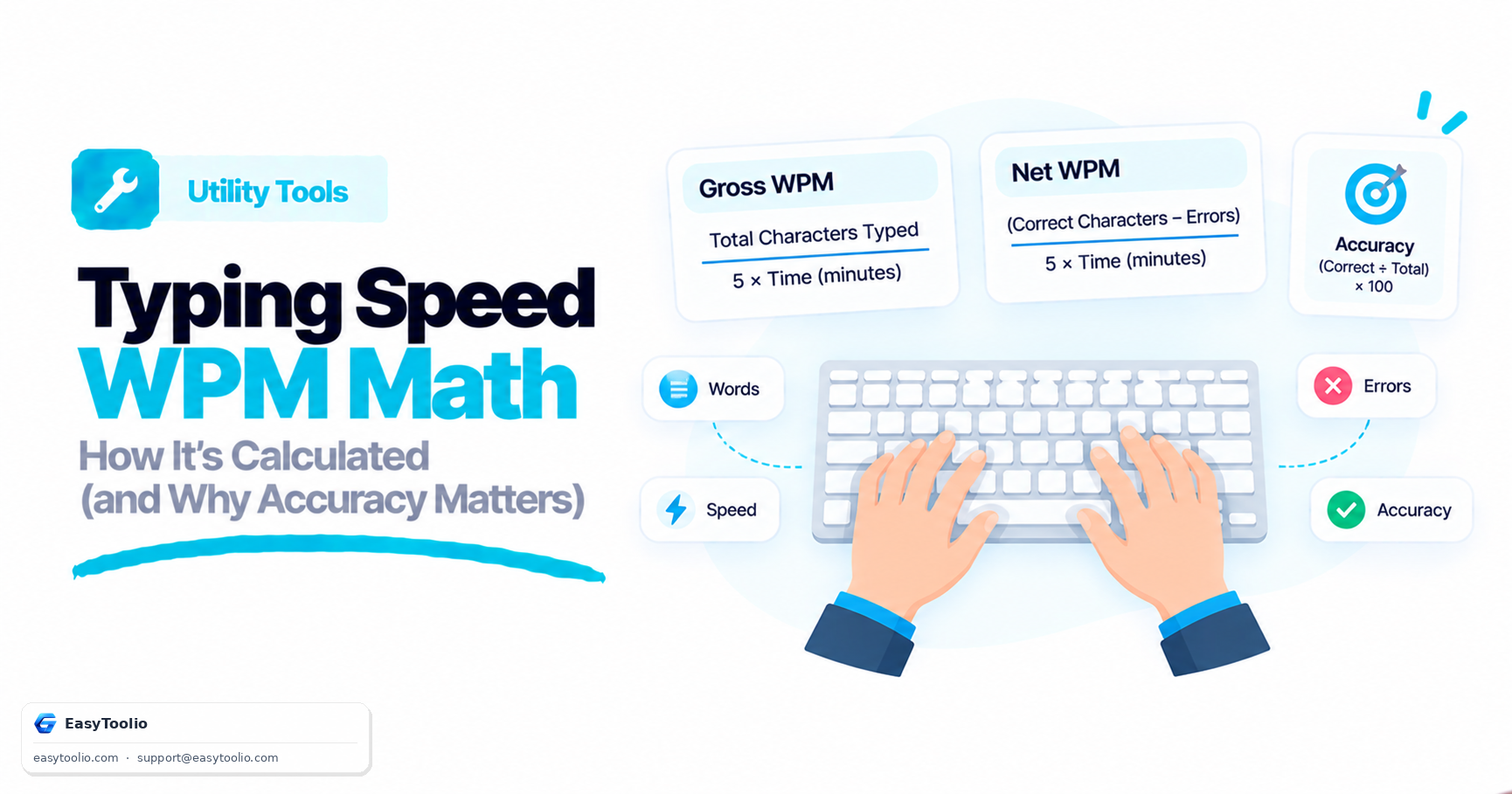
Direct Answer: The near-universal convention is the 5-character word standard: every 5 keystrokes typed (including spaces and punctuation) counts as one "word," regardless of what you actually typed. Gross WPM is your raw typing speed by this standard, with no penalty for mistakes. Net WPM — the number that actually matters for most typing tests and job screenings — subtracts a penalty for uncorrected errors:
Standard words typed = total keystrokes ÷ 5
Gross WPM = standard words typed ÷ time in minutes
Net WPM = Gross WPM − (uncorrected errors ÷ time in minutes)
1. Worked Example
Suppose a candidate types 300 keystrokes in exactly 1 minute and leaves 2 uncorrected errors in the final text:
- Standard words typed: 300 ÷ 5 = 60 words
- Gross WPM: 60 words ÷ 1 minute = 60 WPM
- Net WPM: 60 − (2 ÷ 1) = 58 Net WPM
- Accuracy: ((300 − 2) ÷ 300) × 100 = 99.3%
Now compare a faster but sloppier typist: 360 keystrokes in 1 minute with 12 uncorrected errors.
- Standard words typed: 360 ÷ 5 = 72 words
- Gross WPM: 72 WPM
- Net WPM: 72 − (12 ÷ 1) = 60 Net WPM
- Accuracy: ((360 − 12) ÷ 360) × 100 = 96.7%
Even though the second typist has a much higher Gross WPM (72 vs. 60), their Net WPM ends up barely higher (60 vs. 58) once errors are penalized — a good illustration of why accuracy matters as much as raw speed.
2. Why Errors Are Penalized at All
The logic behind subtracting errors from Gross WPM is that an uncorrected mistake in real-world typing (an email, a document, a transcription) isn't free — someone has to notice it, or it ships with the mistake still in it. Weighting each uncorrected error as a lost "word" approximates the time cost of going back to find and fix it, which is why professional and certification-style typing tests use Net WPM rather than Gross WPM as the headline score.
3. Typing Speed Benchmarks
| Category | Typical Net WPM | Typical Accuracy | Common Context |
|---|---|---|---|
| Beginner | roughly 20–35 | 90%–94% | Just learning proper touch-typing form |
| Average adult typist | roughly 35–55 | 94%–97% | General office and everyday computer use |
| Advanced | roughly 60–80 | 97%–99% | Frequent typists, programmers, writers |
| Professional/expert | 80+ (some specialists well above 100) | 98%+ | Transcriptionists, stenographers, data-entry specialists |
Treat these as broad, commonly observed ranges rather than hard cutoffs — typing speed varies a lot based on the text's difficulty, familiarity with the keyboard layout, and whether autocorrect or predictive text is involved (most legitimate typing tests disable both, since they measure something other than raw manual typing speed).
4. What Actually Limits Your WPM
- Touch-typing technique matters more than raw finger speed — typists who look at the keyboard tend to plateau well below those who've learned proper finger placement and can type without looking.
- Unfamiliar text and punctuation slow everyone down; typing memorized or predictable phrases inflates scores compared to typing genuinely novel text.
- Keyboard rollover limitations can silently cost you accuracy: if your keyboard drops or ghosts a key during a fast multi-finger roll, that shows up as an "error" that wasn't actually a typing mistake.
- Error-correction habits trade speed for accuracy — stopping to backspace every typo slows Gross WPM but can raise Net WPM if it prevents enough uncorrected errors; the right balance depends on the specific test's scoring rules.
5. Why the Same Typist Scores Differently Across Tests
It's common to see your own WPM swing by 10-20 points between different typing tests, and that's rarely a sign your typing genuinely changed — it usually comes down to test design:
- Text difficulty. Common English words with simple sentence structure type faster than random word lists, technical jargon, or heavy punctuation and numbers.
- Test length. Short tests (15-30 seconds) reward a fast initial burst and are more sensitive to a single early mistake; longer tests (1-2 minutes or more) average out over a longer stretch and tend to better reflect sustained typing speed.
- Error handling rules. Some tests let you backspace freely with no penalty beyond lost time; others lock in each character once typed, which changes the optimal strategy for balancing speed against accuracy.
- Familiarity with the exact word list. Tests that reuse the same common word pool let regular users build partial muscle memory for that specific test, inflating scores compared to a genuinely novel passage.
None of this means typing tests are meaningless — it just means a single score is a snapshot under specific conditions, and tracking your trend over multiple sessions on the same test is far more informative than comparing one score against a different test's benchmark.
Measure your own Net WPM and accuracy with our typing speed test, check whether your keyboard can register fast multi-key input cleanly with the keyboard tester and keyboard rollover test, test raw single-key tap speed with the spacebar counter, and compare your typing throughput against broader input speed with the APM test. For the hardware side of fast, accurate typing, see our guide on keyboard ghosting and NKRO.
Frequently Asked Questions
Why does one uncorrected error cost a full word instead of just one keystroke?
The 1-word-per-error penalty is a standardized approximation of the real-world cost of a mistake slipping through — it's a convention from professional typing certifications, not a literal count of how many characters were wrong, and it's designed to reward accuracy roughly as much as raw speed.
Does autocorrect or predictive text count toward WPM?
No — legitimate typing tests disable autocorrect and predictive text, since the goal is to measure your actual manual typing ability, not software assistance.
Is Gross WPM ever the more useful number?
Sometimes, for tasks where speed matters more than polish and errors will be proofread separately anyway (like rough drafting). For anything measuring genuine typing competency, Net WPM is the standard because it accounts for both speed and accuracy together.
How much does keyboard hardware affect WPM scores?
It can matter more than people expect. A keyboard with poor rollover can drop keys during fast multi-finger sequences, registering as errors that weren't really typing mistakes, and switch feel/travel distance affects how quickly and accurately different typists can work.
What's a realistic WPM improvement timeline?
Consistent practice with proper touch-typing technique typically shows noticeable gains within a few weeks, though the rate varies a lot by starting point and practice frequency — steady, error-focused practice tends to improve Net WPM faster than simply trying to type faster.