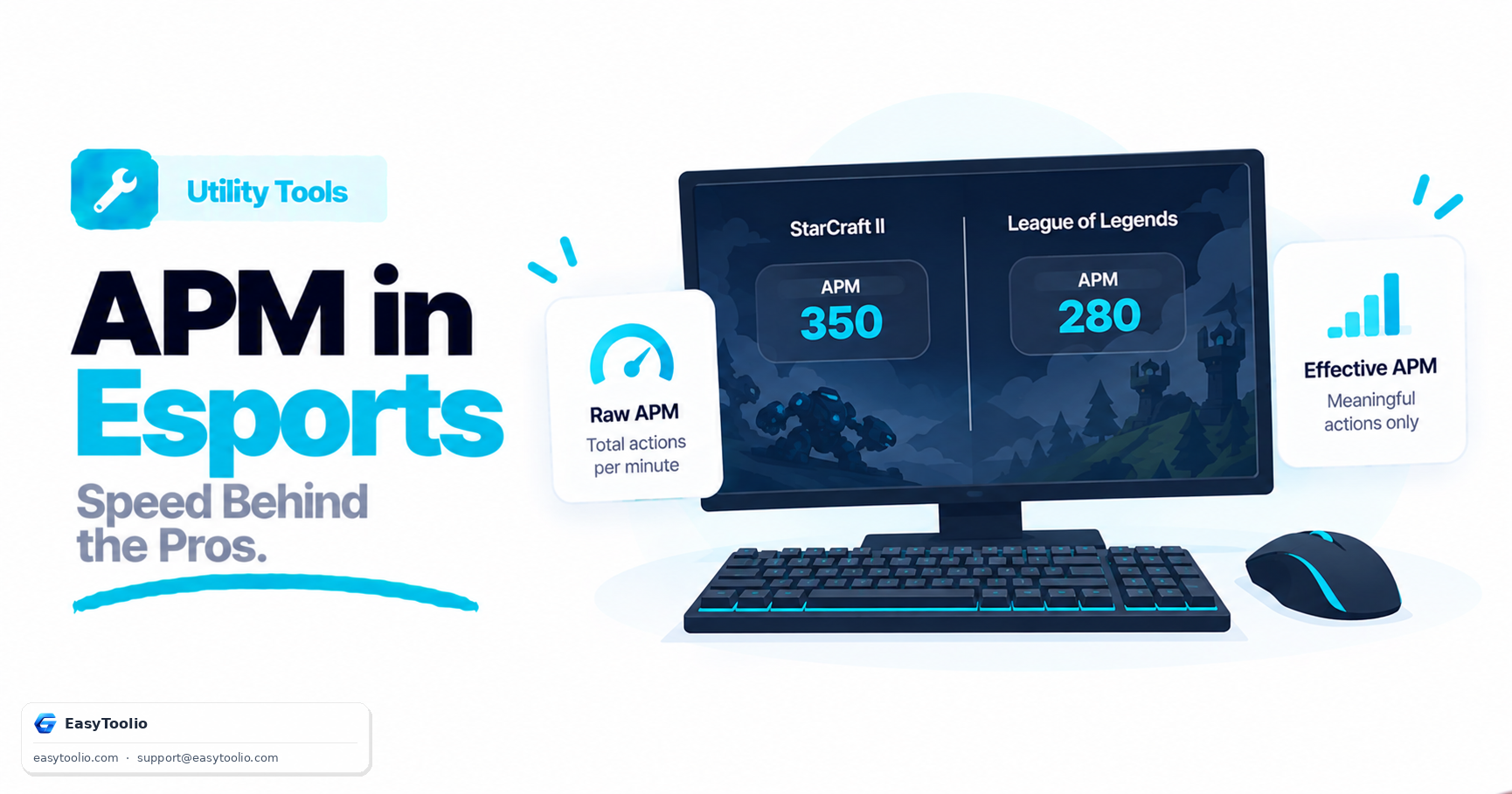
In Real-Time Strategy games like StarCraft II and in MOBAs like League of Legends or Dota 2, Actions Per Minute (APM) is the standard benchmark for how fast a player physically executes inputs. It's often cited as a proxy for skill, though that's only part of the story.
Direct Answer: APM counts the total number of mouse clicks and keyboard presses a player makes in one minute of gameplay. Professional RTS players commonly sustain 200–400+ raw APM, with some spikes well above that during intense fights, while casual players typically sit in the 50–150 range. Raw APM by itself is a noisy number, though, because it counts every input equally — including redundant or "spam" actions. Effective APM (EAPM), a metric popularized by replay-analysis tools, strips out those redundant repeats and counts only inputs that actually changed game state, making it a better (though still imperfect) proxy for meaningful decision-making speed.
1. Raw APM vs. Effective APM
Raw APM      = every click + every keypress, per minute, no filtering
Effective APM = Raw APM minus redundant repeated commands (spam clicks, repeated control-group taps, etc.)
| Metric | What It Measures | Casual Player Range | Competitive/Pro Range |
|---|---|---|---|
| Raw APM | All inputs, unfiltered | ~50–150 | ~250–400+ (bursts can go much higher) |
| Effective APM (EAPM) | Inputs that changed game state | ~40–100 | ~150–300 |
| Typing WPM (a loose proxy for baseline hand speed) | Alphanumeric input speed | ~40–60 WPM | ~80–120+ WPM in fast typists |
Treat the pro-range numbers as commonly cited ballpower ranges from tournament commentary and community analysis rather than a strict official standard — different games, replay parsers, and even different casters define "action" slightly differently.
2. Why Pros "Spam" Inputs Early in a Match
Spectators new to RTS games often notice top StarCraft players rapidly tapping control groups (1-2-1-2-1-2) or clicking the same spot repeatedly during quiet opening minutes, and assume it's meaningless. It usually serves two real purposes:
- Keeping hands warm and rhythm consistent. Sudden bursts of high-speed input are easier to execute cleanly if your hands are already moving at a steady cadence, rather than starting from a dead stop.
- Building a buffer against reaction time. Staying primed at a higher baseline input rate throughout the calm early game reduces the ramp-up delay when a fight suddenly breaks out on two fronts at once.
3. What Actually Counts as an "Action"
Most APM trackers (including in-game overlays and replay parsers) count any registered mouse click or keypress, which means the number is sensitive to a player's habits — someone who taps a control group key three times out of nervous habit racks up "actions" that a stricter EAPM filter would discard. This is the core reason raw APM alone is a weak predictor of skill: a player mashing keys without purpose can post a high raw APM and still lose to someone with a much lower, but more deliberate, EAPM.
4. Building Speed the Right Way
- Learn hotkeys and control groups before chasing speed. Muscle memory for binds is the foundation — trying to type fast on an unfamiliar keyboard layout doesn't work, and the same logic applies to game hotkeys.
- Practice with purpose, not just repetition. Drilling build orders and standard opening sequences builds genuine EAPM, while mindlessly spam-clicking mostly inflates the raw number without translating to better play.
- Track EAPM trends over time, not a single match's raw number. A steady upward trend in effective actions during practice sessions is a far better signal of improvement than one high-APM game.
- Don't sacrifice decision quality for speed. A slower, more accurate player with strong strategy routinely beats a faster player who is reacting rather than planning.
5. APM Expectations Differ by Genre
Not every competitive game rewards the same input rate, so comparing raw APM across genres without context is misleading:
| Genre | Why APM Differs | Rough Typical Range for Engaged Players |
|---|---|---|
| RTS (StarCraft II, Age of Empires) | Constant base management, unit production, and army control across the whole map | Wide range; committed ladder players often land well above casual play, with top pros posting the highest sustained numbers |
| MOBA (League of Legends, Dota 2) | Fewer units to manage than RTS, but frequent ability usage, item actions, and positioning clicks | Generally lower than RTS at a comparable skill tier, since there's less to individually manage |
| FPS (Valorant, CS-style shooters) | APM trackers aren't the standard metric here at all — precision and reaction time matter more than raw input count | APM as a concept is rarely tracked or meaningful in this genre |
This is also why "good APM" advice from one game community doesn't transfer cleanly to another — an RTS player's 250 APM and a MOBA player's 120 APM can represent a comparable level of mechanical engagement within their respective games.
Benchmark your raw execution speed with our APM test, measure pure click speed with the click speed test, check your typing throughput with the typing speed test, and confirm your keyboard can keep up under rapid multi-key combos with the keyboard rollover test. For a deeper look at what separates casual clicking from competitive technique, see our guide on jitter clicking vs. butterfly clicking, and for the exact math behind typing benchmarks, see how WPM is calculated.
Frequently Asked Questions
Does high APM guarantee winning in RTS games?
No. Speed enables faster execution of a plan, but strategy, resource management ("macro"), and decision-making consistently outweigh raw input speed. A player with excellent strategy and modest APM regularly beats a much faster player who is executing a worse plan.
What's a "good" APM for a beginner?
There's no fixed threshold — most new players start well under 100 APM and see it climb naturally as hotkeys and build orders become automatic. Chasing a specific APM number before you're comfortable with your control scheme tends to build bad habits.
Does APM matter in MOBAs the same way it does in RTS games?
Less directly. MOBAs have far fewer units and simpler macro management than RTS games, so APM in a MOBA context usually reflects mechanical skill (combos, kiting, last-hitting) more than multitasking across a whole map.
Can I increase my APM through practice alone?
Yes, to a meaningful extent. Familiarity with hotkeys, muscle memory for repeated sequences, and deliberate drilling of specific mechanics reliably raise both raw and effective APM over weeks of consistent practice.
Is there a maximum useful APM?
Beyond a certain point, additional raw APM mostly adds spam rather than value, since human decision-making can't keep pace with extremely high input rates. Effective APM, not raw APM, is the more meaningful ceiling to chase.