You've put in hundreds of hours in ranked matches and your aim still feels inconsistent — sharp one night, sloppy the next. That inconsistency is rarely bad luck; in-game feedback is slow, noisy, and mixed up with positioning, game sense, and teammates' mistakes, which makes it a genuinely poor environment for isolating and fixing a specific mechanical aim flaw.
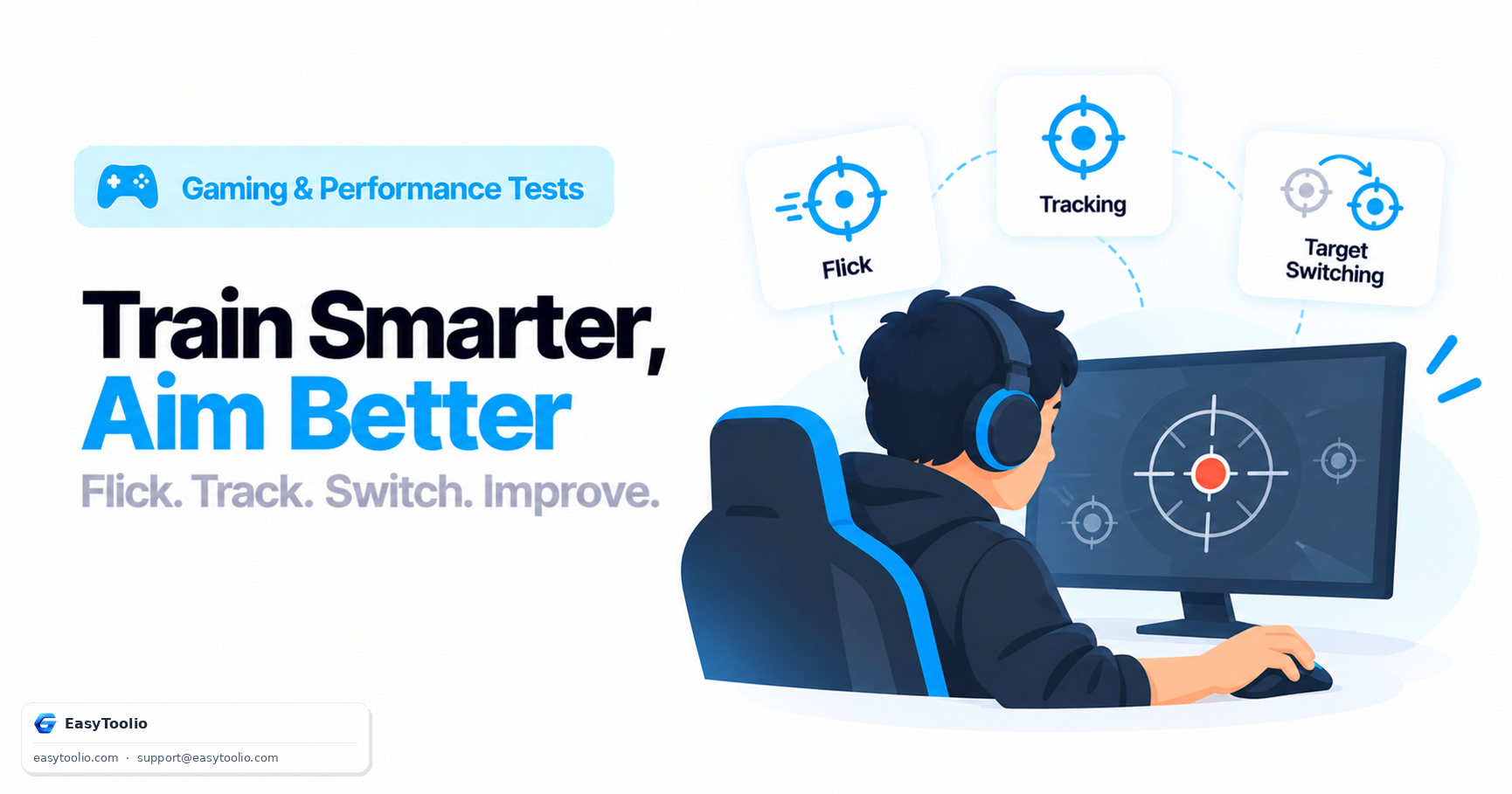
Direct Answer: An aim trainer isolates three core mechanical skills — flicking (rapidly snapping onto a newly appeared target), tracking (smoothly following a continuously moving target), and target switching (quickly transitioning your aim between multiple separate targets) — and gives immediate, precise accuracy and reaction-time feedback on each rep, something regular gameplay can't provide because in-game misses are muddled with lag, positioning errors, and decision-making mistakes. Structured 15-20 minute daily sessions combining all three skill types produce measurably faster improvement than simply playing more ranked matches, because deliberate practice with instant, isolated feedback is what actually drives skill acquisition.
The Three Core Aim Skill Categories
Every real in-game aiming scenario is built from combinations of these three underlying mechanical skills:
| Skill | What It Trains | Example In-Game Scenario |
|---|---|---|
| Flicking | Rapid, accurate snap onto a target that appears suddenly, often at a distance from your current crosshair position | An enemy peeks a corner and you need to snap onto their head instantly |
| Tracking | Smooth, continuous crosshair adjustment to stay on a moving target | Following a strafing enemy while both of you are moving and shooting |
| Target switching | Quickly and accurately moving your aim from one target to a different target | Clearing multiple enemies pushing together in a close-quarters fight |
Most players are naturally stronger at one of these three than the others, and generic gameplay doesn't reliably expose which one is the weak link, since a missed shot in a match could be any combination of the three, plus positioning and decision-making layered on top.
Why Deliberate Practice Beats "Just Playing More"
The concept of deliberate practice — popularized by psychologist Anders Ericsson's research on expertise — holds that skill improvement requires focused practice on a specific weakness with immediate, accurate feedback, not just repeated exposure to the broader activity. Regular gameplay fails this test for aim improvement in several specific ways:
- Feedback is delayed and ambiguous. A missed shot in a match could be bad aim, bad positioning, network latency, or an opponent's superior gear — you often can't isolate the actual cause.
- Reps are inconsistent. A single match might present you with ten flick opportunities and zero tracking scenarios, or vice versa, so you can't guarantee balanced practice across all three skills.
- Outcome pressure interferes with learning. Trying to win a ranked match discourages experimenting with technique changes mid-game, whereas a training scenario has no downside to testing a new grip, sensitivity, or approach.
An aim trainer replaces all of this with isolated scenarios, precise hit/miss tracking, and immediate numeric feedback (accuracy percentage, reaction time, targets-per-minute) after every single run, which is exactly the kind of tight feedback loop that deliberate practice research identifies as necessary for efficient skill acquisition. Run structured flicking, tracking, and switching scenarios directly with our aim trainer to get that immediate, isolated feedback instead of guessing which part of your aim needs work.
Structuring a Daily Aim-Training Routine
A focused, sustainable routine beats an occasional marathon session — most competitive players see better long-term results from short, consistent daily practice than infrequent long sessions:
- Warm-up (3-5 minutes): Easy target-switching or basic tracking scenarios to loosen up hand-eye coordination before attempting harder drills.
- Flicking scenarios (5-7 minutes): Focused reps on sudden-target-appearance drills, tracking your accuracy percentage across attempts.
- Tracking scenarios (5-7 minutes): Continuous-movement drills, focusing on smoothness and minimizing the gap between your crosshair and the target rather than raw speed.
- Target-switching scenarios (5 minutes): Multi-target drills that simulate clearing several enemies in sequence.
- Cooldown and review (2-3 minutes): Check your session stats against previous sessions to identify which of the three skills is improving slowest, and weight tomorrow's session slightly more toward that weak point.
Total time: roughly 20-25 minutes — short enough to sustain daily without burnout, focused enough to produce measurable week-over-week improvement when tracked consistently.
Common Mistakes When Aim Training
- Training only your strongest skill because it feels satisfying, while neglecting the weaker of the three categories that's actually holding back in-game performance.
- Changing sensitivity mid-training-block. Constant sensitivity changes reset the muscle memory your training is trying to build — pick a setting and commit to it for at least several sessions before adjusting.
- Chasing raw score over accuracy. Higher difficulty scenarios that tank your accuracy below a reasonable threshold (commonly under 60-70%) often teach bad habits faster than they build good ones — scale difficulty to maintain reasonably high hit rates while still challenging yourself.
Frequently Asked Questions
How long before aim training shows results in actual games?
Many players report noticeable improvement within 2-3 weeks of consistent daily practice (15-20 minutes), though the exact timeline varies with prior experience and how targeted the practice is toward your specific weak points.
Is aim training a replacement for playing the actual game?
No — aim training builds and maintains raw mechanical skill, but in-game performance also depends on game sense, positioning, decision-making, and communication, none of which an aim trainer can teach. Treat it as a supplement to gameplay, not a substitute for it.
Should I train at a higher or lower sensitivity than I actually play at?
Train at your actual in-game sensitivity, not a different one — the goal is building muscle memory that transfers directly to your real settings, and training at a different sensitivity builds reflexes that don't carry over cleanly.
Which of the three skills should beginners focus on first?
Tracking and target-switching tend to have the most direct, immediate impact on close-range gunfights for newer players, while flicking becomes increasingly valuable as engagement distances and reaction-time demands increase at higher skill levels — though all three are worth training in some proportion from the start.
Can aim training make my aim worse if done incorrectly?
Practicing consistently at a difficulty level far beyond your current skill (very low accuracy) can reinforce imprecise habits rather than correcting them. Keeping difficulty at a level where you maintain reasonably high accuracy, and gradually increasing it, produces more reliable improvement than maximum difficulty from day one.
References: K. Anders Ericsson, "Deliberate Practice and the Acquisition and Maintenance of Expert Performance" (Psychological Review); community aim-training methodology guides from competitive FPS coaching resources.