Someone gets a chart reading and is told they have Kaal Sarp Dosha, and the phrasing alone — "serpent of time" — is enough to cause real anxiety before anyone explains what the term actually describes geometrically in a birth chart.
Kaal Sarp Dosha is one of the more debated placements in Vedic astrology: some traditional astrologers treat it as a significant structural affliction, while many modern practitioners argue it is over-diagnosed and its severity overstated. Understanding the actual geometry behind it is the first step to evaluating either claim.
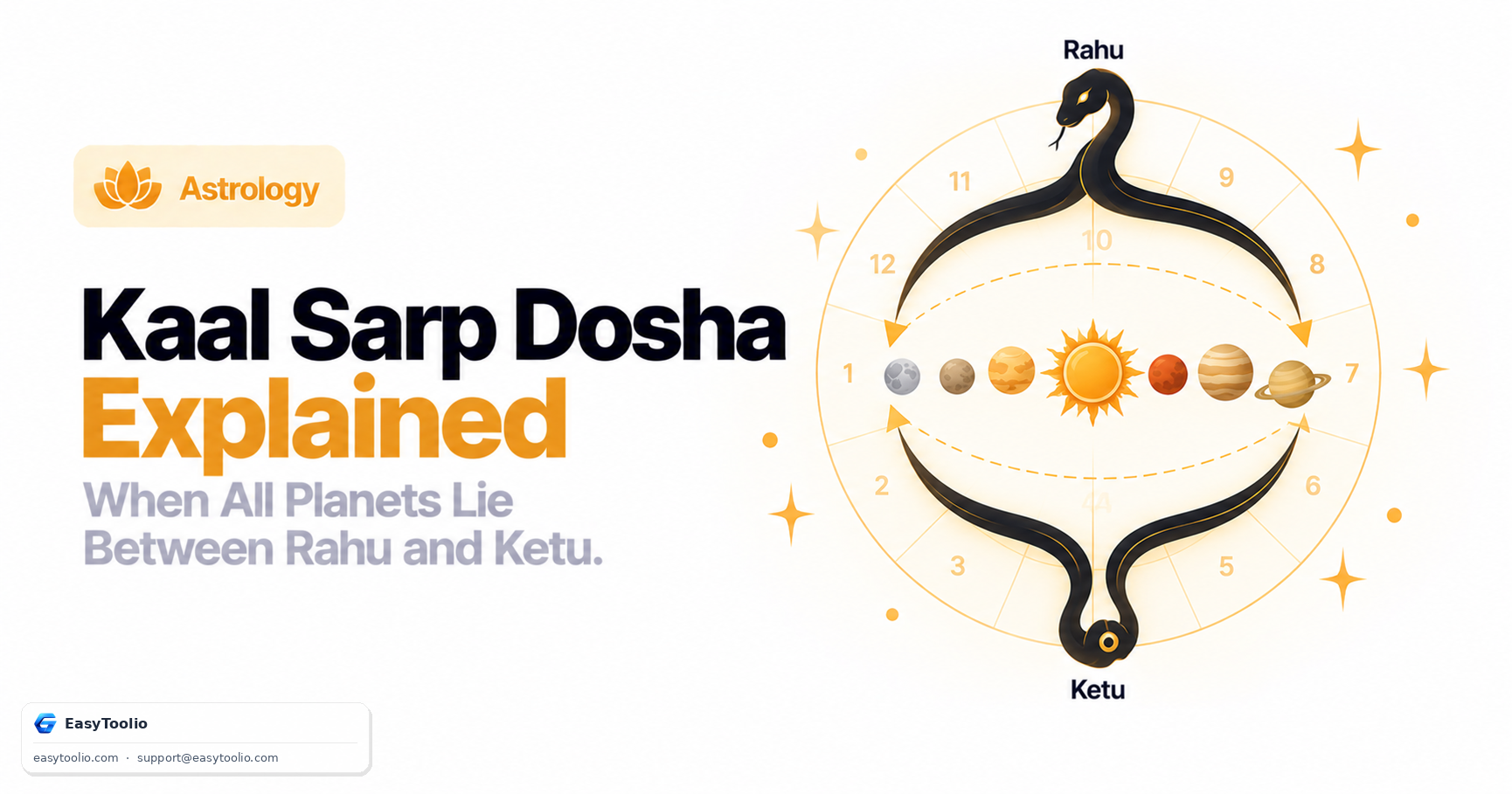
Direct Answer: Kaal Sarp Dosha occurs in a Vedic birth chart when all seven classical planets — Sun, Moon, Mars, Mercury, Jupiter, Venus, and Saturn — fall on one side of the Rahu–Ketu axis, hemmed entirely between the two lunar nodes with none crossing to the other side. Rahu and Ketu are always exactly 180 degrees apart, so this placement effectively traps all other planetary influence within one half of the chart. Classical texts describe this as creating a specific kind of tension or delay in the life themes ruled by the houses involved, and there are traditionally 12 named variations of the dosha, determined by which house Rahu occupies at the time of birth.
1. The Geometry: Why It's Called an "Axis"
Rahu and Ketu are not physical planets but mathematical points — the lunar nodes, marking where the Moon's orbital path crosses the ecliptic. Because they are always exactly opposite each other in the zodiac, they form a fixed axis through any chart. Kaal Sarp Dosha is purely a matter of where the other seven planets fall relative to that axis: if every one of them lands within the same 180-degree arc — all on Rahu's side or all on Ketu's side — the dosha is considered present. If even one planet falls outside that arc, the placement is not formed, regardless of how many planets are clustered together.
2. The 12 Types of Kaal Sarp Dosha
The specific name and claimed effect of the dosha changes depending on which house Rahu sits in, since Rahu's house placement is treated as governing which area of life the "trapped" planetary energy most affects.
| Rahu's House | Name | Commonly Cited Area of Effect |
|---|---|---|
| 1st | Anant Kaal Sarp | Self, health, personality |
| 2nd | Kulik Kaal Sarp | Family wealth, speech |
| 3rd | Vasuki Kaal Sarp | Courage, siblings, communication |
| 4th | Shankhpal Kaal Sarp | Home, mother, emotional stability |
| 5th | Padma Kaal Sarp | Children, education, intellect |
| 6th | Mahapadma Kaal Sarp | Health, enemies, debts |
| 7th | Takshak Kaal Sarp | Marriage, partnerships |
| 8th | Karkotak Kaal Sarp | Longevity, sudden events |
| 9th | Shankhchud Kaal Sarp | Fortune, father, higher learning |
| 10th | Ghatak Kaal Sarp | Career, public reputation |
| 11th | Vishdhar Kaal Sarp | Income, gains, social circle |
| 12th | Sheshnag Kaal Sarp | Losses, foreign travel, spirituality |
Astrologers who use this system also distinguish between a full dosha (all seven planets strictly enclosed) and a partial one (most planets enclosed, with a minor exception), treating the latter as a milder version.
3. Commonly Claimed Effects
Traditional interpretation associates Kaal Sarp Dosha with recurring delays, obstacles, or a sense of struggle in the life areas tied to the specific type above, along with a general pattern of effort not converting into results as smoothly as expected. It is not traditionally read as a curse or as something a person "did" — Rahu and Ketu are karmic significators in this system, so the dosha is generally framed as unfinished karmic business the chart is working through, rather than a punishment.
4. Traditional Remedies
The remedies most commonly prescribed for Kaal Sarp Dosha center on pacifying Rahu and Ketu specifically, rather than the seven enclosed planets:
- Rahu-Ketu Shanti Puja, a ritual performed at temples associated with serpent worship (Nagas), most famously at Trimbakeshwar in Maharashtra, which has become closely associated with this specific dosha.
- Mantra japa, particularly the Maha Mrityunjaya Mantra or Rahu/Ketu beej mantras, repeated a fixed number of times, often using a physical or digital counter to track the count accurately.
- Naga Panchami observance, a festival day specifically tied to serpent deities, considered an auspicious time to perform related remedial rituals.
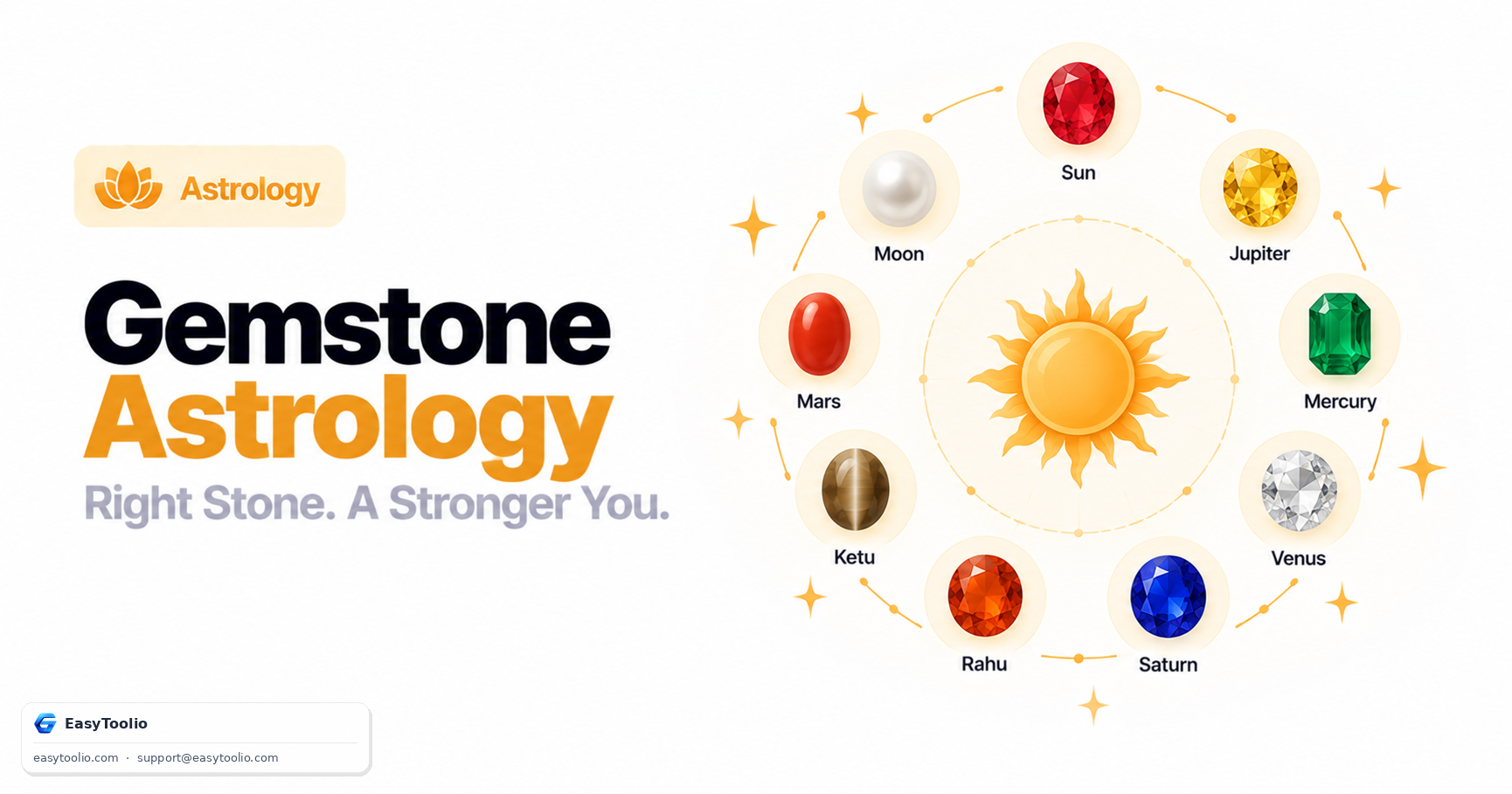
- Wearing Hessonite or Cat's Eye, the gemstones associated with Rahu and Ketu respectively, though only after chart confirmation, since these stones are considered strong-acting.
5. The Modern Debate Over Its Severity
A meaningful number of contemporary astrologers push back on how frequently this dosha is diagnosed, and on how severely it is often presented to clients. Because the definition only requires all seven planets to fall within one 180-degree half of the chart, it is a mathematically fairly common configuration — it does not require any unusual or rare alignment. Critics within the field argue that many charts get labeled with Kaal Sarp Dosha in a shallow analysis that ignores everything else in the chart (the specific dignity and strength of each planet, aspects, house lordships) that would traditionally be needed to assess whether real difficulty is actually indicated. The more balanced position taken by many modern practitioners is that Kaal Sarp Dosha is a real structural feature worth noting, but not, by itself, a reliable predictor of hardship independent of the rest of the chart. If you want to check your own chart for this specific placement, our kaal sarp dosha calculator checks the seven-planet enclosure against the Rahu–Ketu axis directly from your birth details.
Frequently Asked Questions
Does having Kaal Sarp Dosha mean my life will be difficult?
Not necessarily — many practitioners view it as one factor among many in a chart, not a standalone predictor, and its severity is traditionally judged alongside the strength and placement of the individual planets involved.
How common is Kaal Sarp Dosha?
It is relatively common as birth chart configurations go, since it only requires all seven classical planets to fall within one half of the zodiac relative to Rahu and Ketu — no rare alignment is required.
What's the difference between a full and partial Kaal Sarp Dosha?
A full dosha means all seven planets are strictly enclosed between Rahu and Ketu with no exception; a partial dosha means most are enclosed but one planet sits close to, or conjunct with, one of the nodes, creating a milder version.
Can Kaal Sarp Dosha be permanently removed through remedies?
Vedic tradition frames remedies as reducing or pacifying the dosha's difficult effects rather than erasing the placement itself, since the birth chart configuration is fixed at the moment of birth.
Do all astrologers agree that Kaal Sarp Dosha is significant?
No — this is one of the more actively debated concepts in modern astrological practice, with some practitioners treating it as consequential and others arguing it is over-diagnosed relative to its actual predictive value.
References: Traditional Vedic dosha classification as documented in contemporary Jyotisha reference texts; Trimbakeshwar temple's Rahu-Ketu remedial puja tradition.