
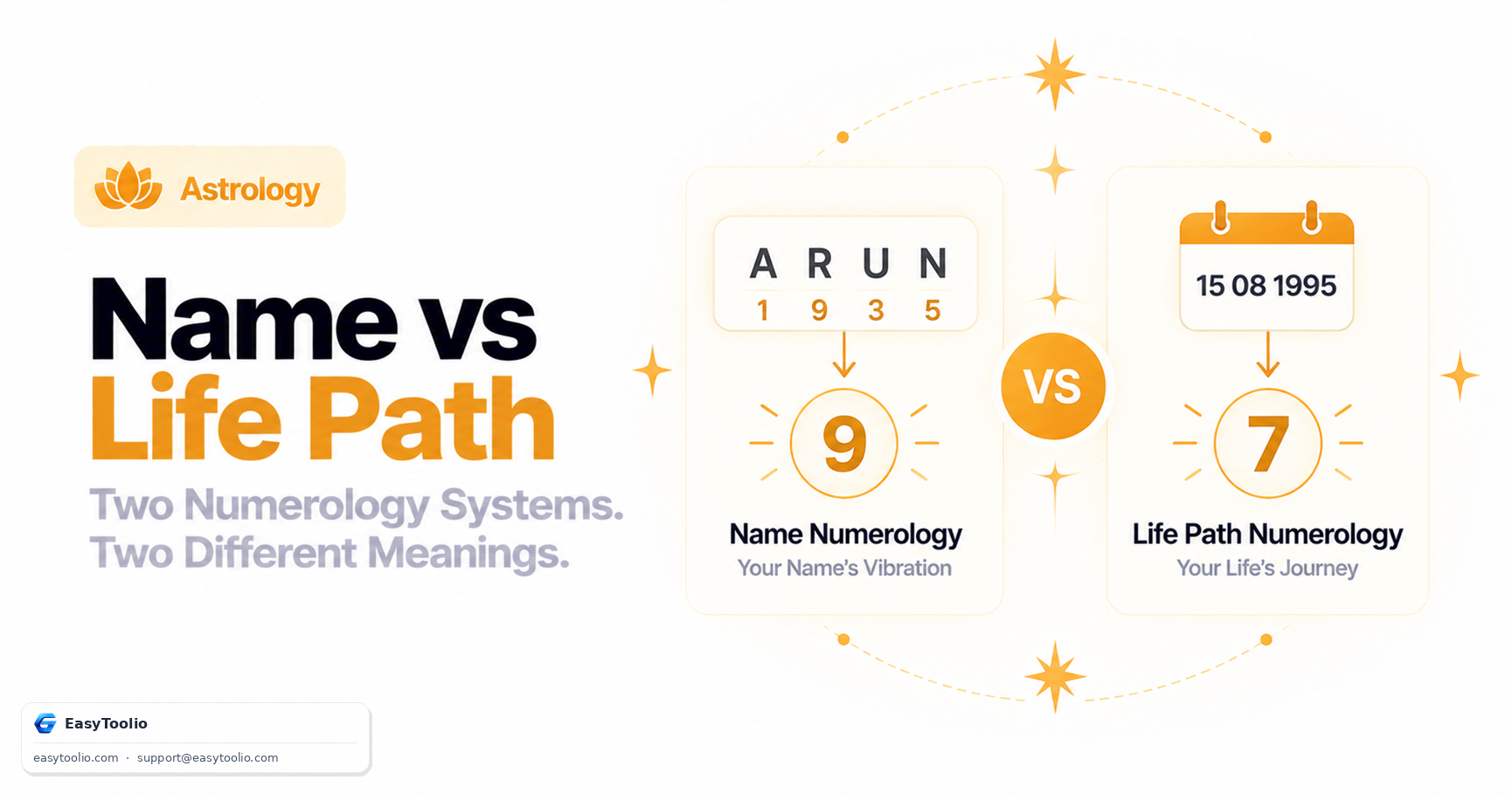
Two people run the same numerology app and get confused when it asks for both their birth date and their full name — if numerology reduces everything to a single digit, why does it need two separate inputs? Because it isn't calculating one number. It's calculating two, from entirely different source data, and they measure different things.
Numerology treats a person's birth date and their name as two independent sources of numerical meaning, each reduced to a single digit (or a "master number" — 11, 22, or 33 — which is traditionally left unreduced) through its own distinct method.
Direct Answer: The Life Path Number is calculated from your full birth date by reducing each part (day, month, year) to a single digit and summing them, and it's treated as representing your innate personality and overall life direction — it never changes. The Name Number (also called the Destiny or Expression Number) is calculated by assigning a numeric value to every letter of your full birth name using either the Pythagorean or Chaldean letter-number system, then reducing that total — it represents how you present and express yourself in the world, and in some traditions is treated as more changeable, which is the basis for "name correction" practices where people alter the spelling of their name to shift this number.
1. Calculating a Life Path Number: Worked Example
To find a Life Path Number, reduce the day, month, and year of birth separately to single digits (unless a master number 11, 22, or 33 appears, which is kept as-is), then add those reduced digits together and reduce again if needed.
Example: Born June 24, 1990
- Month: 6 → already single digit → 6
- Day: 24 → 2 + 4 = 6
- Year: 1990 → 1 + 9 + 9 + 0 = 19 → 1 + 9 = 10 → 1 + 0 = 1
- Sum: 6 + 6 + 1 = 13 → 1 + 3 = 4
This person's Life Path Number is 4, associated with structure, discipline, and reliability. Note some practitioners sum the full birth date digits together in one pass rather than reducing month/day/year separately first — both methods usually converge on the same final digit, though not always, which is a known point of disagreement between numerology schools.
2. Calculating a Name Number: Pythagorean vs. Chaldean
Name numerology assigns a digit to every letter of the alphabet, then sums the digits across your full birth name, reducing to a single digit at the end. The two dominant systems disagree on how letters map to numbers.
| System | Basis | Letter Mapping Style |
|---|---|---|
| Pythagorean | Sequential — letters assigned 1-9 in simple A-Z order, repeating | A,J,S=1; B,K,T=2; C,L,U=3, and so on |
| Chaldean | Older, sound-based — letters grouped by phonetic vibration rather than alphabet order | No letter is ever assigned the number 9, considered too sacred/powerful to assign |
Pythagorean example — Name "ANNA": A=1, N=5, N=5, A=1 → 1+5+5+1 = 12 → 1+2 = 3
The two systems can produce different results for the same name because their letter-to-number mappings are built on different logic — Pythagorean numerology is grid-based and modern (popularized in the West), while Chaldean numerology is considered the older system, rooted in ancient Babylonian numerical-phonetic correspondence.
3. Why People "Correct" the Spelling of Their Name
Because a Name Number is calculated from spelling, not from the sound of a name, numerologists in some traditions recommend altering a name's spelling — adding, removing, or changing a letter — to shift its calculated total toward a number considered more favorable for that person's Life Path Number or current life phase. This is why you'll sometimes see public figures spell their professional name slightly differently from their legal name (an extra vowel, a modified surname), a practice attributed directly to numerological "correction." The Life Path Number, by contrast, is fixed at birth and cannot be changed by any method, since it's derived from an unchangeable date.
Because the two numbers come from different inputs and are meant to describe different things — one your inherent path, one your outward expression — a full numerology profile looks at both together rather than treating either one alone as complete. You can run both calculations from birth details using our numerology calculator, or check a name specifically with our name numerology calculator.
4. What the Numbers 1-9 Are Said to Represent
| Number | Core Theme |
|---|---|
| 1 | Leadership, independence, initiative |
| 2 | Cooperation, diplomacy, sensitivity |
| 3 | Creativity, expression, sociability |
| 4 | Structure, discipline, reliability |
| 5 | Freedom, change, adaptability |
| 6 | Responsibility, nurturing, harmony |
| 7 | Introspection, analysis, spirituality |
| 8 | Ambition, authority, material achievement |
| 9 | Compassion, idealism, completion |
Master numbers 11, 22, and 33 are traditionally treated as carrying amplified versions of 2, 4, and 6 respectively, and practitioners who use them leave them unreduced rather than collapsing them to a single digit.
Frequently Asked Questions
Which is more important, Life Path Number or Name Number?
Neither is considered more important on its own — they describe different things (inherent direction versus outward expression), so a complete numerology reading looks at both together rather than picking one.
Can changing my name spelling actually change my Name Number?
Yes, mathematically — since the Name Number is calculated purely from the letters used, changing the spelling changes the total. Whether that produces any real-world effect is a belief central to numerology practice rather than something independently verifiable.
Should I use my birth name or my current legal name for numerology?
Most numerology traditions specify using the full name exactly as given at birth for core Destiny/Expression Number calculations, while your currently used name is analyzed separately for how you present day-to-day.
Why do Pythagorean and Chaldean systems give different results for the same name?
They use different letter-to-number mapping logic entirely — Pythagorean assigns numbers in simple sequential alphabet order, while Chaldean groups letters by an older phonetic-vibration system and never assigns the number 9 to any letter.
What are master numbers and why aren't they reduced?
11, 22, and 33 are traditionally considered to carry a more intense, amplified version of their reduced counterparts (2, 4, 6), so numerologists who follow this convention keep them as two-digit numbers instead of collapsing them further.
References: Pythagorean numerology as popularized through 20th-century Western numerological practice; Chaldean numerology as documented in traditional Babylonian-derived numeric-phonetic systems.