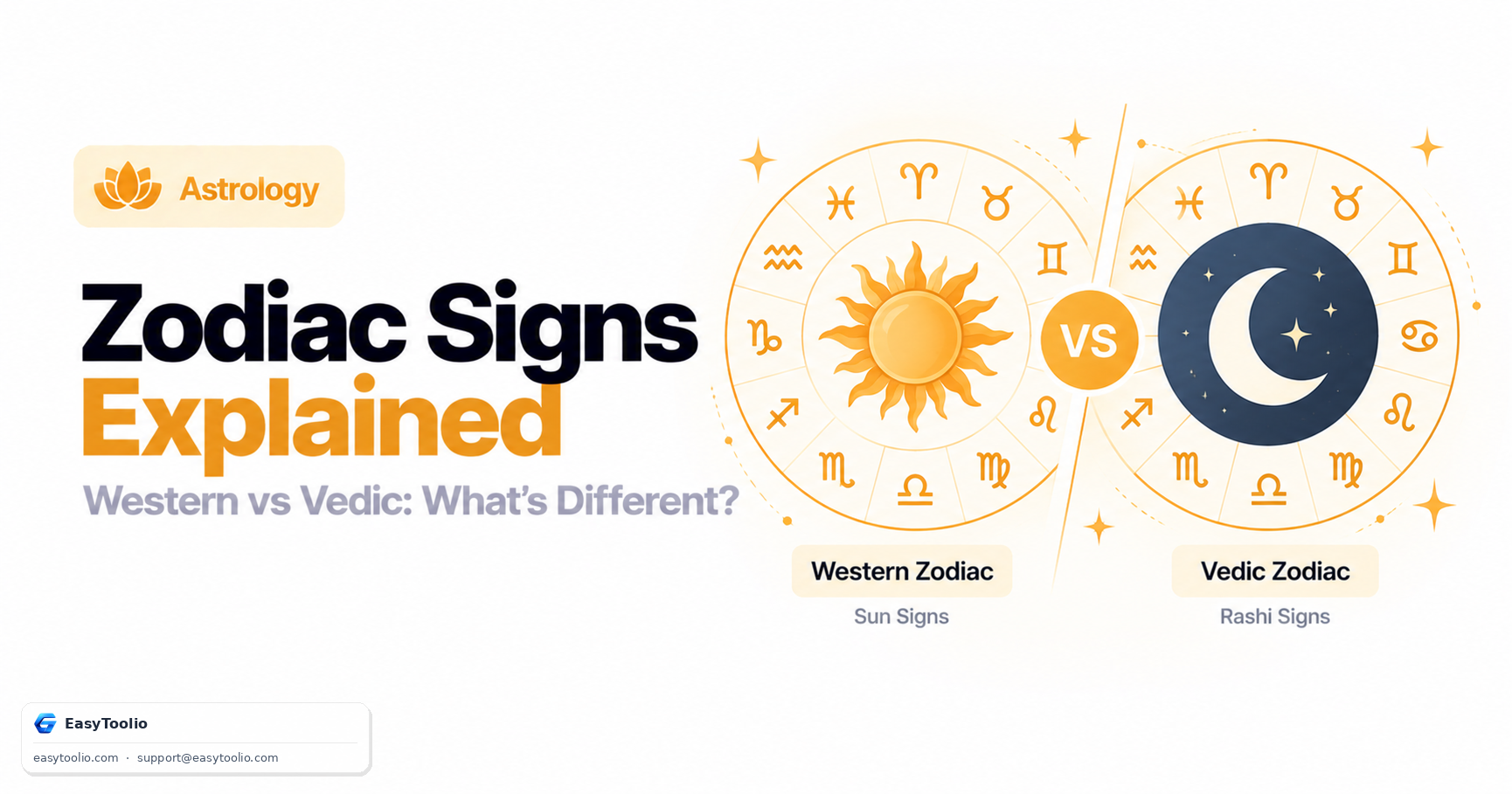
"Why does my Western zodiac sign say I'm a Leo, but a Vedic astrologer told me my Rashi is Cancer?" This is one of the most common points of confusion in popular astrology, and it isn't an error on either side — it's the direct result of two different zodiac systems measuring the sky in fundamentally different ways.
Direct Answer: A Western sun sign is determined purely by your birth date, based on where the Sun appears to be positioned within the tropical zodiac — a system anchored to the seasons (the spring equinox always marks 0° Aries) rather than to the actual visible constellations. Vedic (Jyotish) astrology instead uses the sidereal zodiac, which is anchored to the fixed background stars. Because Earth's axis slowly wobbles over centuries (a phenomenon called precession), the tropical and sidereal zodiacs have drifted apart by roughly 24 degrees today — approximately one full zodiac sign's width — which is why a birth date that gives you "Leo" in Western astrology frequently corresponds to "Cancer" as your Vedic Rashi.
1. How a Western Sun Sign Is Determined
In tropical (Western) astrology, the zodiac is divided into twelve equal 30-degree segments starting from the exact point of the spring equinox, regardless of which constellation is actually behind that point of the sky in a given year. Your sun sign is simply the segment the Sun was passing through on your birth date. You can find your sign instantly by birth date using our zodiac sign calculator.
2. The 12 Western Zodiac Signs and Date Ranges
| Sign | Date Range | Element |
|---|---|---|
| Aries | March 21 – April 19 | Fire |
| Taurus | April 20 – May 20 | Earth |
| Gemini | May 21 – June 20 | Air |
| Cancer | June 21 – July 22 | Water |
| Leo | July 23 – August 22 | Fire |
| Virgo | August 23 – September 22 | Earth |
| Libra | September 23 – October 22 | Air |
| Scorpio | October 23 – November 21 | Water |
| Sagittarius | November 22 – December 21 | Fire |
| Capricorn | December 22 – January 19 | Earth |
| Aquarius | January 20 – February 18 | Air |
| Pisces | February 19 – March 20 | Water |
These date boundaries can shift by a day depending on the specific year, because the equinox itself does not fall on exactly the same calendar date every single year.
3. Tropical vs Sidereal: Why the Systems Diverge
Both systems divide the sky into the same twelve named segments of 30 degrees each, but they disagree on where the starting point (0° Aries) actually sits:
- Tropical zodiac (Western astrology): Anchored to the Earth's relationship with the Sun — 0° Aries is fixed at the moment of the spring equinox every year, regardless of the stars behind it.
- Sidereal zodiac (Vedic/Jyotish astrology): Anchored to the actual fixed background stars (constellations) as they were originally mapped in classical antiquity.
Because of Earth's axial precession — a slow 26,000-year wobble of the Earth's rotational axis — the point marking the spring equinox has drifted westward relative to the fixed stars over the centuries. The angular difference between the two systems today is called the ayanamsa, currently around 24 degrees (roughly the Lahiri ayanamsa value commonly used in Indian Vedic astrology). Since each zodiac sign spans 30 degrees, a 24-degree ayanamsa means your Vedic Rashi is very often the sign immediately before your Western sun sign.
4. Comparison Table: Tropical Sun Sign vs Vedic Rashi
| Feature | Western Tropical Sign | Vedic Sidereal Rashi |
|---|---|---|
| Reference point | Spring equinox (seasonal) | Fixed background stars |
| Adjustment for precession | Not applied | Applied via ayanamsa (~24°) |
| Typical shift from Western sign | — | Often one sign earlier |
| Common use | Popular sun-sign horoscopes | Kundli, Dasha, and detailed predictive astrology |
| Governing calculation | Calendar date-based | Exact birth time, date, and location-based |
5. Why This Matters Beyond Curiosity
The distinction is not just trivia — it explains why someone reading a Western sun-sign horoscope column and getting a full Vedic Kundli reading can receive descriptions that feel like they're about two different people. Neither system is "wrong" within its own tradition; they are simply two independent frameworks with different reference points, developed in different cultural and historical contexts, and neither is scientifically validated as predictive — they represent belief systems with internally consistent rules rather than empirically tested models.
Frequently Asked Questions
Why is my zodiac sign different in Western and Vedic astrology?
Western astrology uses the tropical zodiac anchored to the equinox, while Vedic astrology uses the sidereal zodiac anchored to the fixed stars. The roughly 24-degree gap between the two systems (called the ayanamsa) means your sign often shifts by one position between the two.
How is a Western sun sign calculated?
It is calculated purely from your birth date, based on which 30-degree tropical zodiac segment the Sun was passing through on that date, regardless of your birth time or location.
Do I need my exact birth time to find my Western sun sign?
No, not usually — your sun sign only requires your birth date. However, if you were born very close to a sign boundary date, exact birth time and location may occasionally be needed to confirm which sign applies.
Is Vedic Rashi the same as a moon sign?
Yes, in most usage, "Rashi" in Vedic astrology refers to the Moon sign — the sidereal zodiac sign the Moon was positioned in at your birth — which is different from the Sun-sign-based Western system.
Which zodiac system is more accurate?
Neither system has been scientifically validated as predictive; they are distinct traditions with different internal logic and calculation methods, and preference between them is generally a matter of which astrological tradition you follow.
References: Zodiac sign date ranges and precession/ayanamsa mechanics described here follow standard conventions of Western tropical astrology and Vedic (Jyotish) sidereal astrology, including the widely used Lahiri ayanamsa; these systems represent traditional belief frameworks rather than scientifically validated predictive models.