
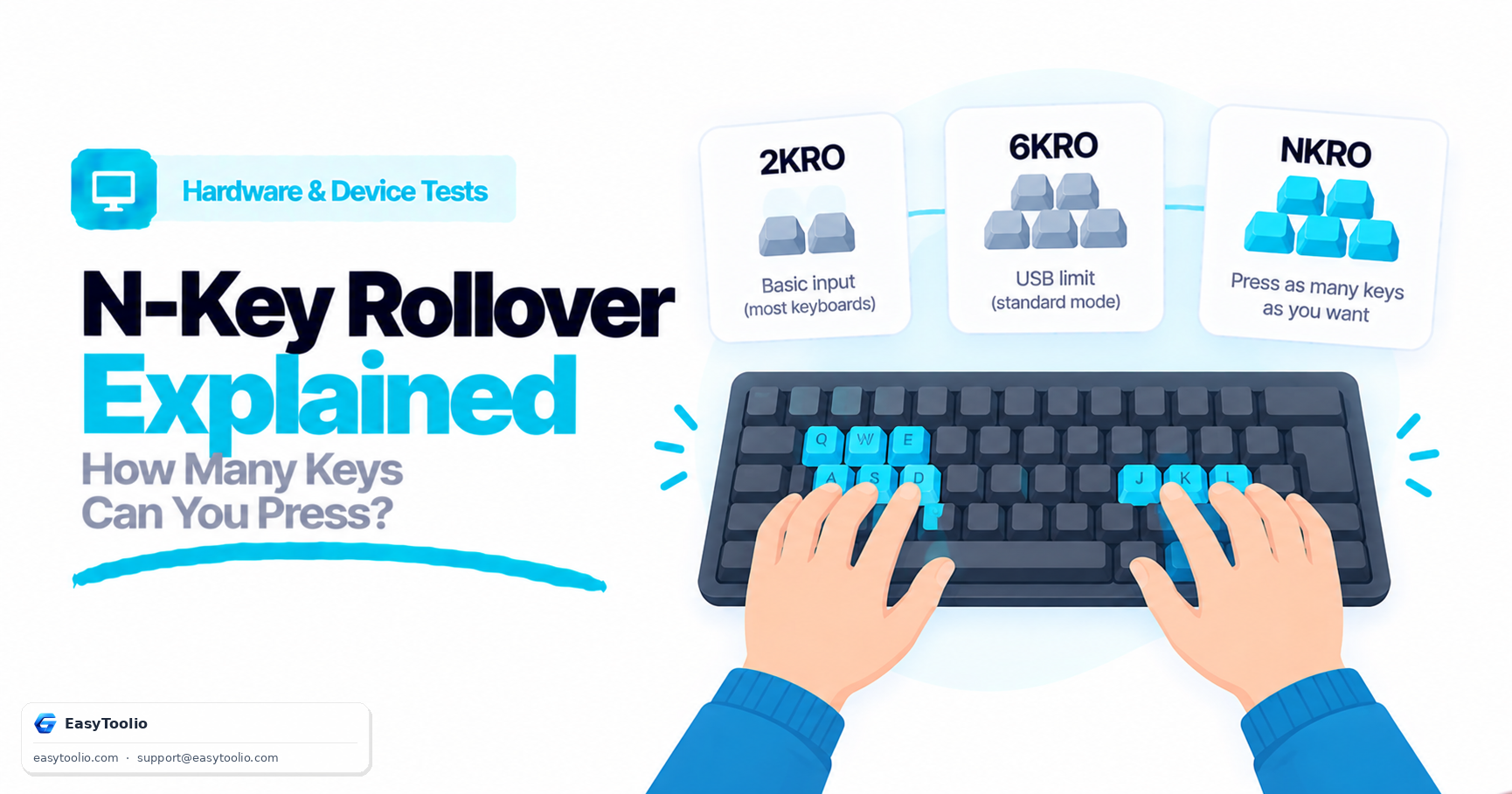
"Rollover" is one of those keyboard specs that gets thrown around as a single yes/no feature — a keyboard either "has NKRO" or it doesn't. In reality, rollover is a spectrum with several distinct tiers, and understanding where a keyboard sits on that spectrum matters more than just chasing the highest number.
Direct Answer: Key Rollover describes how many keys a keyboard can correctly register as held down at the same time. 2-Key Rollover (2KRO) was the historical baseline for basic keyboards, reliably registering only two simultaneous keys. 6-Key USB HID boot-protocol rollover (6KRO) became the practical, widely-supported limit for decades, allowing six standard keys plus modifier keys simultaneously. Full N-Key Rollover (NKRO) allows simultaneous detection of every single key on the board at once, with no ceiling. Which tier actually matters depends heavily on use case: typing rarely needs more than 4 to 6KRO, while certain gaming key combinations genuinely benefit from full NKRO.
1. The Rollover Spectrum
2KRO ────────────► 6KRO ────────────► NKRO
(2 keys reliable)  (6 keys + mods)    (Every key, unlimited)
Historical basic   USB boot-protocol  Requires dedicated matrix
membrane keyboards practical standard diodes or advanced scanning
| Rollover Tier | Simultaneous Keys Reliably Registered | Where It Comes From | Typical Keyboard Class |
|---|---|---|---|
| 2KRO | 2 keys | Simple membrane matrix without anti-ghosting design | Basic/legacy keyboards |
| 6KRO | 6 standard keys + modifier keys (Ctrl/Shift/Alt/Win) | Standard USB HID "boot protocol" 8-byte report | Most mainstream keyboards |
| Full NKRO | Effectively unlimited (all keys at once) | Per-switch isolation diodes, or a non-boot-protocol HID report format | Enthusiast mechanical / gaming keyboards |
2. Why 6KRO Became the Long-Standing Practical Limit
The USB HID "boot protocol" — designed decades ago so that a keyboard works in a BIOS/UEFI environment before any operating system driver loads — uses a fixed 8-byte report format: one byte for modifier keys (Ctrl, Shift, Alt, Win) and six bytes for standard keys. That structural limit of six simultaneous non-modifier keys is exactly why "6KRO" became the long-standing practical ceiling most mainstream keyboards shipped with, even though nothing about typical typing or general computer use ever approached that limit.
Keyboards that want to exceed 6KRO have to either use a custom, non-boot-protocol HID report format (a bitmapped report that can represent every key as an individual on/off flag) or expose a separate virtual HID endpoint dedicated to extended rollover, both of which require deliberate firmware and matrix design.
3. Why Rollover Depth Matters Differently by Use Case
- General typing: Even fast typists rarely have more than 3 to 4 keys mechanically depressed at the exact same instant, since finger movements are naturally staggered. 6KRO comfortably covers virtually all typing scenarios, including modifier-heavy shortcuts.
- Gaming — movement clusters: Common WASD-plus-modifier combinations (e.g., moving diagonally while crouching and reloading) can genuinely stack five or six simultaneous keys, which is exactly why 6KRO became the gaming-keyboard marketing baseline.
- Gaming — full NKRO scenarios: Rhythm games, fighting games with complex simultaneous button inputs, and some MMO keybind layouts can occasionally require more simultaneous keys than 6KRO supports, which is where full NKRO provides a genuine, measurable benefit rather than just a marketing bullet point.
Test how many simultaneous keys your keyboard can register using our web keyboard-rollover-test.
4. Common Misconception: Anti-Ghosting Is Not the Same Thing as NKRO
These two terms get used almost interchangeably in keyboard marketing, but they describe different, if related, properties:
| Term | What It Actually Describes |
|---|---|
| Anti-Ghosting | A matrix design goal: preventing the matrix from reporting a phantom key that was never physically pressed, for a specific set of key combinations the manufacturer tested and wired around |
| N-Key Rollover (NKRO) | A rollover depth claim: how many simultaneous keys can be correctly registered at all, regardless of which specific combination is pressed |
A keyboard can be "anti-ghosting" for a curated set of common gaming key combinations (say, WASD plus a handful of nearby modifier and ability keys) without offering full NKRO across the entire board. This is why some keyboards marketed as "anti-ghosting" still fail to register certain unusual key combinations outside the specific cluster the manufacturer tested — the anti-ghosting design solved for likely combinations, not for every possible combination the way true full NKRO does.
5. How to Test Rollover Yourself, Step by Step
- Start with a baseline. Press and hold two adjacent keys (e.g.
AandS) and confirm both register in the tester. This confirms basic 2KRO works. - Add modifier keys. Hold
Ctrl,Shift, andAlttogether with a couple of standard keys. Since modifiers are reported in their own dedicated byte in the USB HID boot-protocol report, most keyboards handle this combination without issue even at only 6KRO. - Stack standard (non-modifier) keys. Hold down six or more non-modifier keys spread across different rows and columns of the keyboard simultaneously, and watch which ones the tester shows as registered versus dropped.
- Note the pattern, not just the count. If keys drop out in a way tied to specific rows/columns rather than simply "after N keys," that points to a matrix-diode limitation specific to that key combination — useful information beyond a single rollover number.
- Repeat across different areas of the board. A keyboard's rollover capability is not always uniform everywhere; some designs have stronger anti-ghosting coverage around the WASD/arrow-key cluster than elsewhere on the board.
6. Frequently Asked Questions (FAQs)
Do I need a full NKRO keyboard for everyday office typing?
No. 6KRO comfortably handles ordinary typing and shortcut use. Full NKRO mainly benefits gaming scenarios involving many simultaneous key combinations, or specialized use cases like MIDI-style simultaneous multi-key input.
Is NKRO always enabled by default on a keyboard that supports it?
Not always. Some keyboards ship in a 6KRO USB boot-protocol compatible mode by default (for broadest BIOS/OS compatibility) and require a driver, firmware toggle, or key combination to switch into full NKRO mode.
Can a browser-based test measure true full NKRO?
A browser test can verify rollover up to the number of keys you physically hold down during the test, and can demonstrate whether 6+ simultaneous keys register correctly, but confirming an exact upper NKRO ceiling for every key on the board typically requires pressing large groups of keys across the entire matrix systematically.
Does Bluetooth or wireless connectivity limit rollover?
It can. Some Bluetooth HID profiles and wireless dongle implementations impose their own report-size constraints independent of the keyboard's internal matrix capability, meaning a keyboard capable of full NKRO over a wired USB connection may fall back to a lower rollover ceiling over Bluetooth. Checking the specific wireless mode's documented rollover support is worthwhile if this matters for your use case.
References: USB Implementers Forum Device Class Definition for Human Interface Devices (HID v1.11).